Tuesday, December 30, 2008

Into the cold

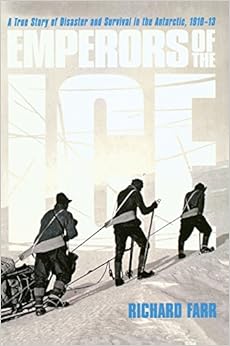
While the name Robert Scott might be known to teen readers, it is unlikely that they have read about some of the more successful aspects of his fateful 1909 journey to the South Pole. As he explains in the preface to his new book, Emperors of the Ice, author Richard Farr was particularly taken with the “Winter Journey” portion of that expedition. Later recounted by Apsley Cherry-Garrard in his bestselling narrative The Worst Journey in the World, the trip to collect Emperor penguin eggs nearly killed “Cherry,” Dr. Edward Wilson and Lt. Henry Bowers. As it turned out Wilson and Bowers did not survive the race to the Pole with Scott and it was only Cherry who was later able to provide the first person account of Scott’s dedication to science. Unfortunately, Cherry’s book is a bit of a “doorstop” as Farr puts it. A lot of readers might be intimidated by its size (almost 600 pages) or its age. This is most true for teen readers for whom the adventurous aspects of the book would otherwise be very appealing. So Farr wrote about the journey in an easier format. Heavily illustrated with maps and photographs from the expedition, Emperors of the Ice is exactly the sort of book that readers eager for the unknown will adore.

One interesting choice Farr made was to write the book from Cherry’s perspective. Relying primarily on Worst Journey for his text, Farr crafted a book that literally places the reader there with Cherry, Bill Wilson and Birdie Bowers as they struggled against enormous odds (and nearly died) in pursuit of the hidden secrets of bird evolution. While science has proven that Wilson’s thesis about the penguins was incorrect, the larger idea that birds and dinosaurs were related is true. But more amazingly, discovering that polar explorers actually risked their lives in pursuit of ornithological revelations is heartening in the best sort of way. They were brave and superhumanly determined and it was all for science. After so many books about winning it is wonderful to be reminded that Scott was in a race only because it was thrust upon him by circumstance; that his goal was always just to learn more. (Something that Richard Byrd and George Catlin would both understand.) Emperors of the Ice manages then to salute both men of adventure and intellect. There are action movies and video games and then there is what was accomplished at the bottom of the world nearly a century ago. This is thrilling writing and it will hopefully open up a whole world of polar literature to readers looking for something to believe in.

Cross-posted at Bookslut
with review of other books for curious minds.

Monday, December 29, 2008

The Brimstone Network by Tom Sniegoski

The Brimstone Network by Tom Sniegoski

Picture the X-Men, or the cast of Heroes. Now picture them younger, right when they are discovering and harnessing their powers, and you've got The Brimstone Network. It's an organization of warriors, sorcerers, and superpowered folks. Bram, a young teenager who is half-human, half-specter, inherited leadership of the group when his father, the original leader of the group, was killed in an attack that almost wiped their ranks out entirely. Now Bram not only has to find new recruits, he has to try to fill his father's shoes and keep the legacy alive.

The new and youthful members of The Brimstone Network have powers and abilities that fans of Heroes would love to have, like telekinesis and shapeshifting (psst . . . one of the main characters is a werewolf!) Some are tentative while others are tenacious. They must learn how to control and use their powers safely. Meanwhile, there are a number of villains who will stop at nothing to get what they want. For example, the second book introduces an evil vampire who can't be killed. Yikes.

If you are in the market for a new supernatural series for young readers, you've got to get this series. The Brimstone Network has lots of action and suspense, and it would be a really cool TV show or movie. I'm a sucker for stories with superpowers, and I really like how the different members of the Network struggle with their newfound abilities.

The Shroud of A'Ranka by Tom Sniegoski

The first book in the line is simply called The Brimstone Network. The second book, The Shroud of A'Ranka, officially comes out tomorrow, December 30th, but it has already crept steathily into some stores. The third book, Specter Rising, will be released on January 27th. I can't wait to read it - and I really hope that Simon & Schuster lets the series continue!

In this series and others, Tom Sniegoski treats his young male protagonists very well. He lets them be boys, lets them be kids, even if they are in a hurry to grow up or have the weight of the world on their shoulders. His hilarious Owlboy series is for the same target audience as Brimstone, as is the magical OutCast quartet, which he wrote with Christopher Golden. There's also The Fallen, an angelic fantasy quartet which I highly recommend to teens and adults, plus his mystery novels for adults (A Kiss Before the Apocalypse, the forthcoming Dancing on the Head of a Pin) which feature Remy Chandler, an immortal, angelic private investigator.

For more information about the author and the series, visit www.sniegoski.com and www.sniegoski.com/brimstone I recently added a bunch of icons and wallpapers to the Brimstone site, thanks to the folks at Simon and Schuster, including illustrator Zachariah Howard and designer Karin Paprocki. Bram kind of looks like a young Indiana Jones on the second book cover, don't you think?

Friday, December 26, 2008

On Behalf of the Spirit

Yeah, so the Spirit is getting the living spit kicked out of it in pretty much every review out there. If you've read any of them, you've heard all the bad stuff already, but what none of them said was this: writer/director (and comic book re-inventor) Frank Miller has tried to distill certain mythic and aesthetic elements of the super-hero comic book into this two-hour movie and he's mainly succeeded. If you specifically love what super-hero comic books have to say and the way that they say it, then you will find a lot to enjoy about this movie.

And while I've got you here, check out Will Eisner's original Spirit comics; there's about a zillion collected editions around now (but this one's a fine place to start). If Jack Kirby gave comic books their energy and power, then it was Eisner who gave them their unique form of expression. It's been said that he invented the language of the comic book the way Orson Welles defined the language of cinema with Citizen Kane. And you better believe that this is the only place you are ever going to see the Spirit movie and Citizen Kane mentioned in the same paragraph.

Addictive holiday reads

Okay, I *am* visiting my girlfriend's family over the holidays, but it isn't this bad.

But that didn't stop me from packing what I hope are a couple of really fun books: 1) the graphic novel based on Prince of Persia (which David wrote about a couple months ago, and which I've been coveting as I've been contemplating getting PoP for my 360) and 2) Red Seas Under Red Skies, the sequel to the Lies of Locke Lamora.

When I was packing, I realized that's one of my personal holiday traditions (which I bet I share with many GLW readers): losing myself in a good book after the haze of food and presents and visiting--usually a fun, light book, and always something that keeps me turning the pages.

Here are a few of my favorite page-turners from past holidays:


  • The Lies of Locke Lamora: This is fantasy, but it isn't Lord of the Rings. Locke Lamora is an orphan, an incredibly gifted grifter, and the leader of a gang called the Gentlemen Bastards. Think of it as "caper" fantasy--sort of like Fafhrd and the Gray Mouser crossed with Ocean's 11. I plowed through almost all 752 pages this Thanksgiving weekend! (Not surprisingly given its fast-moving plot, it's already being adapted as a movie.)

  • Requiem for a Ruler of Worlds: This is a goofy, engaging space opera with highwire action and a Hitchhiker's Guide-style sense of humor (e.g., one of the protagonists' names is "Alacrity Fitzhugh"). The two follow-up books are equally worthwhile (Jinx on a Terran Inheritance and Fall of the White Ship Avatar), and this great author is also responsible for some equally page-turning fantasy and Han Solo stories.

  • Fred Saberhagen's Book of Swords: I remember finishing this post-apocalyptic fantasy series over successive Christmas breaks in junior high and high school, and they're still some of my favorites. Saberhagen often starts with an ingenious "what if?" in his stories (much like in his famed SF Berserker series, with its self-replicating misanthropic robots), and the Book of Swords is no different. In this three-part series (with several "Lost Swords" follow-ups that'll have you combing through used-book stores), the gods have scattered twelve unique Swords of Power--with names like Coinspinner, Shieldbreaker, and Farslayer--across the world, as a game for mortals to fight over.


I'm obviously prejudiced towards SF and fantasy here, but if anybody else wants to share their ideas for good, light reads amidst the holiday daze, please add them in the comments!

Wednesday, December 24, 2008

Nexus - Best Comic Book Ever?


Here’s a Christmas treat for someone…
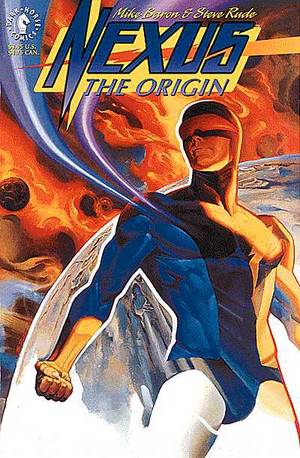
Nexus: The Origin, a fine comic book by Mike Baron and Steve Rude.
… to be given away to a deserving young reader.

Like Scrooge on Christmas morning, I throw open my shutter anxious to share the good things of life with others.
Now don’t get me wrong. This comic book -- or should I say graphic novella -- is not from my personal horde of Nexus comics. Heaven forefend!
However, I found it in a shoppe recently and thinking that it was a perfect introduction to the greatest superhero comic series ever written, I decided to scoop it up and make sure it got into deserving hands.
Yes, I’m giving it away to a lucky Guys Lit Wire reader. Keep reading for details…


What’s so great about Nexus?
It’s just one of those things where two great talents collide and create something more than a masterpiece, since after all any old master can make a masterpiece. This is rarer still.
The artist Steve Rude is simply astonishing. A designer of both pages and panels. An artist with wild new ideas and a love of old-school illustration. And a dude -- The Dude, he calls himself -- who is not above sneaking Kirk and Spock or something Seuss-ish into a book.
The writer Mike Baron is no slouch either, as they say. He’s got some big ideas and in Nexus he has found a way to turn them into a cracking good tale.

It’s a unique story among superheroes and Baron and Rude have found many ways to keep it taking new, surprising, even frustrating turns.
The hero, Horatio Hellpop, is tormented by dreams of mass murder. Dreams in which he feels the agony of every victim. The dreams don’t stop until he personally tracks down the killer and execute him.
To do this, Horatio has been given nearly infinite power. In most cases, the murderers stand no chance at all. In fact, in one of the finest stories, Horatio must kill a feeble old woman.
In this book, Nexus: The Origin, we see two of his first killings and two of the most interesting. In one we see Horatio -- now the all-powerful Nexus -- do some eye-ball popping, shazaam-tastic, comic-book blasting! But in the other, we see Nexus arrive to take down a horrible Nazi-ish figure. Like many of the Nazis, he’s no super-villain, just a bad, pudgy man.
Nexus come blazing in, like a million superheroes have done before. (Except drawn better.)
“Stand up and take it like a man!” he demands of his victim.
The man just cowers.
“NO? Then let your death be a little thing … quickly forgotten.”
He lays a finger on the man’s head. The murder is done.
And then the starving, tortured survivors crawl forth from the rubble. They need a place to go. Horatio decides to give them asylum, attempting to create a better society, but such a thing is never easy…

Once you’ve read this origin. You’ll be ready to plunge in. There are many issues of Nexus, several graphic novels and the occasional new book.
You’ll find many items at http://www.steverudeart.com/Comics_s/2.htm
or at TFAW, the amazon of awesome.
Otherwise, check your local comic shop or library.
One of our local libraries has a Nexus graphic novel in the Kiddie Comics section. Nope, this isn’t for kids.

If you’d like to get be the proud owner of Nexus: The Origin, send an email to sam@riddleburger.com with Nexus in the subject line and I’ll randomly pick a winner from all entries.


Tuesday, December 23, 2008

What It Is by Lynda Barry

Reviewed by Steven Wolk

I post my reviews on the 25th of each month. This review spot in Guys Lit Wire--the 23rd of each month--is normally the place for Dewey's book review. Tragically, Dewey passed away recently. I was asked this month to post in Dewey's spot. I did not know Dewey, who was an English teacher (and that tells me something about her), but I want to acknowledge that this is her place. I'm just a guest today. Rest in peace.

There is just one Lynda Barry. Artist, playwright, novelist, comic creator. Lynda Barry is an original, and as my Grandma used to say, they made her and broke the mold. Her book, What It Is, is a visual and creative marvel. Nearly every page is a mixed media collage made up of found images, original painting, found text, added text, manipulated text, and photos. Barry puts them all together to create a beautiful and stimulating image on each page. You can spend hours looking at all of the details and reading the bits and pieces of text scattered around the pages.

Separately, the pages are a feast for the eyes, but together they are meant to motivate and inspire the artist and writer and thinker and creator inside each of us. Barry offers writing workshops, and this is a book version of her workshop. Most of the collage pages center around a question: What is the past made of? What are we doing when we are looking? Do memories have mass? Can images exist without thinking? Do you wish you could draw? What is intention?

What makes What It Is especially interesting--and gives it a vital dimension--is a running autobiographical narrative through the book. Barry relates key periods in her life that either hindered or energized her creativity. From her mother to her art teachers to her own self-doubt, Barry tells a compelling story that shows how easy it is for the people and systems around us to obstruct--or even destroy--our creativity, curiosity, wonder, and our youthful urge to create. In a nation (and a larger belief system of schooling) that does not value art, imagination, or questioning the status quo, What It Is serves as a bright beacon to nurture and appreciate the artist and thinker inside all of us.

I assume some readers will be compelled to just flip through this book to look at the amazing imagery and read an occasional piece of text. While there is nothing wrong with roaming through a book--in fact, this book makes marvelous meandering material--I urge readers to actually read the book. When you finish it you will feel the power and the joy of this wonderful thing called imagination.

Monday, December 22, 2008

Thaw by Monica M. Roe

Just one month ago, Dane Rafferty was the best skier on his high school skiing team. He was smart, dating a great girl, then all of a sudden, paralyzed by Guillain-Barre Syndrome. Dane has heard the doctors talking and knows there's a good chance he'll recover. Actually, forget the 75% chance the doctors are quoting—Dane truly believes he'll recover completely in just a month or two. After all, nothing has ever stopped him before.

I'll be honest here: Dane is the most obnoxious, unlikable protagonist I've read about this year. He was also one of the most compelling characters I've read about this year. Maybe it sounds callous, saying I found a guy who used to be active and athletic but is now paralyzed to be obnoxious and unlikable. But, seriously, the guy's a jerk, and you can't blame the stress of falling ill or working hard in therapy for it. Most of the book is set in Florida, at the rehabilitation hospital Dane is convalescing at, but Roe devotes several chapters to Dane's pre-GBS life, and he was just as arrogant, selfish, and self-centered then as he is in Florida. (I'd actually prefer to call him something else, but I'm not sure it's allowed here at Guys Lit Wire.)

Liking a character and finding him compelling, caring about what happens to him in one way or another, are completely different things. Dane could be Exhibit A highlighting this difference. But I can't imagine Thaw working if Dane was depicted a nice guy. It would be too easy to pity him, to wish all of his problems would magically be resolved. As it is, Monica M. Roe has created a believably annoying, aggravating narrator in Dane, and the progress he makes—both physically and in terms of his personality—feel earned.

Thaw is a Cybils YA Fiction nominee and you can chalk this one up as another book I never would have picked up if it hadn't been nominated but am glad I read.

[cross-posted at The YA YA YAs]

Friday, December 19, 2008

Shift

Shift is every bookseller's dream because it is perfect for hand-selling. I mean, all you've got to say in your sales pitch is this: "So this story is about two friends who go on a bike trip across the country the summer before college and at the end of the summer, only one of the boys comes home. The other one disappears." Done. Sold. The customer is at the cash, money in hand, probably already reading the first page. Jennifer Bradbury sure came up with a premise that would make any author envious. What a great hook. I am happy to report that Shift lives up to the promise of its premise, one-hundred percent. Not only is this story a page-turner, it's a thought-provoking, nuanced read that touches on some pretty profound ideas about growing up, making your own way in the world and learning to let go. I've thought about the characters and the themes in Shift many times over the past weeks. This is a story that sneaks up on you and stays there.

Stories about journeys just about always work for me. I wonder if it's that I enjoy thinking about how a character's physical journey inspires or mirrors his/her emotional growth. This is certainly the case in Shift. Chris and Win experience the challenges of a demanding physical undertaking and as they get through those experiences (flat tires, crazy winds, rain and more rain), they find out more about themselves. It's almost like the journey brings them to greater understanding of themselves and of their friendship.


I will not reveal much more about the plot than I've already written because part of the pleasure of the story is the element of mystery. I liked the tension Bradbury created from the start. You really wonder what has happened to Win (the friend who disappears), and you feel like Chris (the one who comes home) may have secrets. You don't really know who is reliable. That's part of what keeps you turning the pages. Of course, there's also the fact that Chris and Win's friendship is completely convincing - in the way that they banter and get on each other's nerves and know when to be supportive and when to just back off. The way that the narrative is structured with Chris remembering the events of the summer almost as flashbacks interspersed with his present experiences at university was a smart move since this jacks up the suspense. As we read Chris's memories of the summer, we're ever-aware of the fact that things "ended badly," so we're always on the look out for what when wrong, just waiting for the trip of a lifetime to turn sour. Aside from suspense, this structure also creates a feeling of poignancy, because readers know that the good times the boys enjoyed were bound to come to an end before they arrived at their destination. The early part of their trip really reads like a golden time.

I love that this book inspires you to think about how profoundly mysterious just about everyone is, even the people we think we really know. Everyone has secrets, and secrets usually inspire the choices individuals make about where they want to go, and who they want to be. Shift is about trying something wild and crazy without really thinking it through, and how this sort of bigger-than-life experience can make you know yourself in ways you could never predict.

Shift is such an accomplished piece of writing that it's hard to believe that it is a debut title. I guess that makes Jennifer Bradbury a born storyteller. Lucky for us, Jennifer is hard at work on more novels and has already sold 3 books to Atheneum. Good news indeed. Find out more about Jennifer in my recent interview with her at Shelf Elf and in Carter's October Interview with Jennifer right here at Guys Lit Wire. Shift belongs at the top of your To Be Read pile. You'll whiz through it and then you won't stop thinking about it. Maybe you'll be tempted to plan an escape of your own.

Thursday, December 18, 2008

Ever heard of Afrofuturism?


I've been thinking a lot about race of late, and not because of the recent election, our president-to-be, or the significant way in which Barack Obama has brought front and center many of our still simmering concerns about racial divisions in this country.

No, it was this blog post about, of all things, the newest incarnation of Jack Kirby's New Gods which sparked my interest. In it, David Brothers imagines superhero Scott Free as the apotheosis of Afro Futurism, an African-American and African-Diaspora expression of technology, science fiction, and the future (to grossly generalize).

Eventually, I get from here to a "Star Wars"-ian slave epic and a history of North America so beautiful it will terrify you and break your heart. Come with me after the jump to see how...

So, after reading that article, I was struck by how easily I have overlooked black SF, a lit tradition that's long-in-the-tooth enough and broad enough to include W.E.B. DuBois and George Clinton, Bootsy Collins, and the entirety of P-Funk mythology. Seriously, it never occurred to me that African American lit has a huge science fiction vein. I remember when Walter Mosley's Blue Light came out a decade ago, I thought he'd gone off the deep end.

It never ceases to amaze me all the ways I can have my head up my ass when it comes to issues of race and gender.

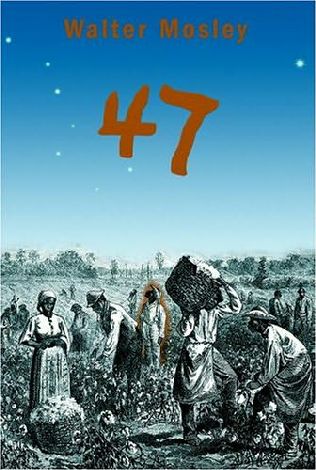
Anyways, I figured I'd rectify some of my ignorance by returning to Mosley, and picked up a copy of 47, his only venture into YA lit. The premise is this: an alien comes to earth, finds the one man destined to save the universe, and readies him for his fate. Only here, the destined savior is a slave in 1830's Georgia who is so stripped of identity he has no name, only the number 47.

First, before I go any further, if you've read any Walter Mosley, you know the taut, charged writing and full, burgeoning characters in his books. If not, this is a great place to begin. But here's the amazing thing: not only is this a great book that combines standard SF tropes with historical fiction, it turns inside-out some of the standards of science fiction. What happens when the evil empire of space opera is the slave-owning south, and the opressions inflicted by them are real, identifiable--even un-ignorable.

It strips away the safe distance discussions of the future can sometimes inhabit. You re-think nearly every SF book and movie you've ever encountered. Take Star Wars, for instance: what kinds of things was the Empire doing to maintain its stranglehold on all those planets. And not the antisceptic horrors onscreen, but the systematic, ongoing oppression of entire peoples. Stripping them of everything, even their names. Stripping them to the bone.

It's a slim volume, and ends before the epic part even takes off, but as a fresh look at history and a take on some of the old, worn out SF tropes, it really twists the knife. For an even slimmer, yet even more epic science fiction take on slavery, I pulled out a book I've been hanging on to for awhile but hadn't yet read: Terry Bisson's fantastic Fire on the Mountain.

Today is the anniversary of the 13th amendment, the one that abolished slavery. And I think, especially in the wake of our historic election, we have a tendency to think of racism as over, or at the very least, abated. Not racism on the small, individual scale, like racial slurs or even, God forbid, dramatic acts of violence. Not even the scale that we think of when we think big: restaurant chains refusing to hire or promote people because of their race, or, say, the visual impact of this political cartoon.

No, I'm talking racism on the largest of scales, scales that push us into places very, very uncomfortable to imagine. Places in imagination that force us to completely reimagine the world, possibly better or possibly worse, but stripped of some of our most venerated concepts and institutions if only to reduce the tremendous weight of something that infects, without us realizing it, how we define nearly everything around us, our institutions both public and private, even our very selves, whatever our race.

This is what SF, at its best, can do, though. Create ideas so powerful they make us tremble, and Fire on the Mountain is just such a book. Alternate histories have come into their own of late, but this one, over twenty years old by an unsung hero of SF, is about as phenomenal as alternate history speculative fiction can get.

Set in 1959, Fire on the Mountain opens on the eve of the second expedition to Mars, hyper-fuel efficient green technology cars and living matter shoes giving us glimpses of the utopian super-science at play in this very different world, a world radically different from our own in the most crucial sense of the word. This world made possible by a single event: the success of John Brown's raid on Harper's Ferry in 1859.

In Bisson's alternate history, the ensuing century saw the rise of an entirely different America, indeed, an entirely different world: one in which the aforementioned amazing technological advances came not from this continent, but the continent of Africa--one in which global issues of poverty and conflict are much less prevalent. The tradeoff is nearly every institution Americans hold dear. There is no more United States, no Deep South, no Abraham Lincoln freeing of the slaves.

In Bisson's vision, John Brown's victory turned the Civil War into a slave revolt whose ultimate result is the establishment of an independent black nation called Nova Africa where the US South is today.

The great thing about all alternate histories is that they make our past more vivid, more real because we can see what was at stake in the choices that were made in the past. We understand just how fragile our notions of the inevitable can be. But the best alternate histories give us a vision of just how far we have to go to achieve our greatest hopes and dreams, even when we think our best historical moments are triumphs of the human spirit.

Hmm. I did go on a bit here. Rather than me blabbing on about this, instead check out these books:

47 by Walter Mosley is still widely available, but Terry Bisson's Fire on the Mountain is out of print. May I suggest one of these fine sources if your local library doesn't have it?

Also, if you're intrigued by Afrofuturism, which I barely touched upon, check out the anthology Dark Matter, edited by Sheree Thomas. It's fantastic, packed with lots of great short stories, including the aforementioned story by W.E.B. DuBois.

Wednesday, December 17, 2008

Some recommendations

A couple of recommendation lists caught my eye recently. First, author Jeff Ford has his top ten titles read this year over at Omnivoracious which includes the following (note that these are not all brand new books which is cool):

"The Best of Lucius Shepard and The Best of Michael Swanwick – I’m double dipping here, I know, but these two reprint collections are by two of SF/F’s best ever short fiction writers. From genre defining to genre breaking works and beyond, the reader is treated to continually great fiction. These are those kinds of books that if you don’t acquire them now, some day you’ll wish you had."

Both of those collections are from Subterranean Press, one of the best publishers in the business and particularly excellent when it comes to fantasy.

Some of you may recall thirteen-year old Max Leone's comments to PW about books guys want to read which we linked to here last month. (He was especially interested in a book about vampires that wasn't also about vampire romance.) (You do remember when vampires were something scary, right?) Max had a guest post last week at The Swivet where he gave some "holiday book recommendations for the teenage boy in your life". He has nonfic, manga, John Twelve Hawks and Terry Pratchett which is pretty much as eclectic as it gets. Here's my favorite of his reviews:

"SMARTBOMB: The QUEST for ART, ENTERTAINMENT, and BIG BUCKS in the VIDEOGAME REVOLUTION by HEATHER CHAPLIN and AARON RUBY (Copied more or less word-for-word from the book cover. It looked much less ridiculous there): Though the title alone makes it illegal to bring this book onto an airplane nowadays, it is another book that will be re-read countless times, as proved by my copy looking like a walrus sat on it. For several hours. Anyway, it features great information on the history of videogames. Recommended for gamers and non-gamers alike."