Tuesday, December 2, 2008

Who's funniest: Plato, Descartes, or Sartre?


Multitasking has been getting a lot of bad press lately. You’re not even supposed to talk on your cell phone while you drive anymore. They say it causes accidents. Well, here is a multitasking project that you can do safely. Suppose you’ve been hired to MC a Moose Lodge event. Suppose at the same time you are about to appear on Jeopardy and one of the categories, you’ve been told in advance, is Western Philosophy. You can get jokes for your event and information for your game show appearance at the same time if you read Plato and a Platypus Walk into a Bar . . . : Understanding Philosophy through Jokes, by Thomas Cathcart and Daniel Klein. Neat, huh? Just don’t do it while driving.

In fact, by reading this book you can simultaneously become educated in philosophy and expand your joke repertoire even if you have no game show appearances or MC gigs in the near future. Why put together jokes and philosophy? Besides being a more enjoyable way to learn philosophy than Western Philosophy for Dummies, the authors contend that philosophy, which is an attempt to understand the incomprehensible through language, and jokes, which use language to make you laugh, very often use the same central ideas to get to their separate ends. Plato and a Platypus supports this thesis well. Plus, it’s really funny.

There are some who enjoy philosophy and can vigorously debate such questions as free will versus determinism through the night and well into the morning. There are others who find philosophical arguments complex and jargon-ridden, and there are still others who ask “what does it matter” and simply don’t see the point in having a philosophical discussion at all. Cathcart and Klein are not unsympathetic to any of these positions, and their humor often reflects the absurd nature of philosophy as a discipline. If you love to indulge in the knots of existential thinking, they have a joke for that. But if you’re confused and befuddled by questions of reality and observation, they have a joke for that, too.

The jokes do have a certain similar tone throughout. Most seem to have been inspired by vaudeville comedians like Buddy Hacket and George Burns Here’s an example:
“My Grandfather knew the exact time on the exact day of the exact year he would die. “
“Wow! What an evolved soul. How did it come to him?”
“The judge told him.”

Ba-da-dum.

Really, the book ought to come with its own rim-shot kit. There are a number of jokes which take place at the gates of heaven, several involving psychiatrists, several which include (apparently Jewish) mothers, and a couple of travelling salesman jokes. You have to really enjoy that kind of humor to fully appreciate the book. And you have to wonder if other types of humor would so easily tie work with a discussion of philosophy. Here’s another one:
Salesman: Ma’am this vacuum cleaner will cut your work in half
Customer: Terrific! Give me two of them.

Some of the jokes illustrate the tenets of logic, some of them illustrate logical fallacies or the limits and failures of particular philosophies and some, are, well, just jokes that are inspired by a particular philosophy. If the book has a flaw, other than that all the humor is all pretty similar in tone, it’s that sometimes the jumps between explaining a philosophy and the jokes are a bit sudden. Cathcart and Klein, although committed to the task of relating in sensible terms the history of philosophy, simply can’t pass up a good opportunity to tell a joke. “That reminds me of a good one. . .” could introduce any number of jokes in the book.

Of course, that’s some serious nitpicking. Really, would you want to have it any other way? I mean would you want a guy who was telling you a perfectly good travelling salesman joke to interrupt himself and say, “That reminds me of a great essay by Foucault about knowledge and power?” No, you would not.

The book does clarify a great deal about philosophy for me, mostly because it simplifies many of the more difficult ideas, and it has given me a number of new jokes to try out on my family and friends. My wife was handy on several occasions as I read the book, so I tried some out on her. Unfortunately, I had to go through a half dozen before I got her to laugh at one. Like I said, this humor isn’t for everyone (or maybe there’s something to the talent of the joke teller). But here, from the book’s section on religious philosophy is her favorite:
If you have an ice cream cone, I will give you an ice cream cone.
If you need an ice cream cone, I will take your ice cream cone away.
That is an ice cream koan.

Monday, December 1, 2008

In which another adult says silly things about teen readers

I really think Caitlin Flanagan (and The Atlantic) jumped the shark with this ridiculous article about teen fiction, "What Girls Want". Here are my biggest eye rolling quotes:

1. "Divorce in a young-adult novel means what being orphaned meant in a fairy tale: vulnerability, danger, unwanted independence. It also means that the protagonists must confront the sexuality of their parents at the moment they least want to think about such realities."

(News to Hilary McKay, Barbara Shoup, Cecil Castellucci and hundreds of other authors who have written realistic novels about kids from broken homes who do not live like the children in fairy tales.) (And really - when did we decide it was still okay to make sweeping statements like this about any facet of society, let alone literature?)

2. "I hate Y.A. novels; they bore me."

(Which explains why you are writing an article on YA novels, of course.)

3. Twilight is fantastic.

(Sweet Jesus.)

4. "After a friend (toward whom Bella has gently been directing one of her own admirers) finally goes on a big “date” (a lost world right there, in a simple word), she phones Bella, breathless: “Mike kissed me! Can you believe it?” It was a scene that could have existed in any of the books I read when I was an adolescent; but in today’s world of Y.A. fiction, it constitutes an almost bizarre moment."

(Because apparently modern YA fiction is full of porn. I'm sure this will be news to Sherman Alexie, John Green, Chris Crutcher and pretty much every other YA novelist on the planet.)

5. "This is a vampire novel, so it is a novel about sex, but no writer, from Bram Stoker on, has captured so precisely what sex and longing really mean to a young girl."

(I've heard Bram Stoker credited for many things but never that he was attempting to capture what "sex and longing" meant for young girls.) (And really - ew.)

6. "As I write this, I am sitting on the guest-room bed of a close friend, and down the hall from me is the bedroom of the daughter of the house, a 12-year-old reader extraordinaire, a deep-sea diver of books. She was the fourth person through the doors of the Westwood Barnes & Noble the midnight that the series’ final volume, Breaking Dawn, went on sale, and she read it—a doorstop, a behemoth—in six hours, and then turned back to page one as though it were the natural successor to the last page."

(This would be the part where we see why Flanagan is qualified to write this article - she knows a 12 year old! Of course she thus knows every single thing there is to know about teenagers and books!)

And the one that particularly addresses our concerns here at GLW:

7. "The salient fact of an adolescent girl’s existence is her need for a secret emotional life—one that she slips into during her sulks and silences, during her endless hours alone in her room, or even just when she’s gazing out the classroom window while all of Modern European History, or the niceties of the passé composé, sluice past her. This means that she is a creature designed for reading in a way no boy or man, or even grown woman, could ever be so exactly designed, because she is a creature whose most elemental psychological needs—to be undisturbed while she works out the big questions of her life, to be hidden from view while still in plain sight, to enter profoundly into the emotional lives of others—are met precisely by the act of reading." (emphasis mine)

(No comment from me - just the sound of my head hitting the desk over and over again.)

[See Finding Wonderland and Miss Rumphius for more discussion of this truly inane piece of journalism.]

The Secret History of Moscow


Ekaterina Sedia's The Secret History of Moscow evokes two distinct, vivid worlds unfamiliar to mainstream US readers. First is Moscow of the 1990s, with Communism dead, gangsters staking their claim to the beginnings of democracy and most people keeping their heads down and getting by. Second is the underworld beneath Moscow, where storybook creatures, Pagan gods and disposessed humans live an eternal life of...well, getting by.

Random Muscovites are disappearing, and eyewitnesses swear they turn into birds and fly away. Galina, a young woman who has always seen things fluttering at the edges of her vision, loses her sister in this way. Yakov, a weary young policeman fully aware of his pointless job, tries to help. Fyodor, a reprobate street artist, has the clue they need: he's seen swarms of birds fly in and out of the underworld. These three pilgrims enter this strange but sweetly mundane spiritual realm hoping to find the reason for these transformations, and a way to help Galina's sister.

Sedia (author of The Alchemy of Stone) uses a prose style that is brisk, strong and clear. She doesn't waste a lot of time on subplots or needless description, nor does she scrimp on background. She keeps the characters' relationships, even the non-human ones, refreshingly realistic. Even immortal deities and creatures who inhabit nightmares speak with distinct personality and without any of that faux-formal talk so often used to designate otherworldliness. The underworld itself avoids the accepted cliches of faerie, becoming a distorted mirror-image of the society above it without lapsing into either blatant politics or satire (there is a lot of commentary on what it's like to live in Russia both past and present, but it never comes across as didactic). And most delightfully (to me, at least, as a reader weary of such things) it's not the first of a trilogy or a series. It's a self-contained one-off tale that sets up its characters and themes, then resolves them beautifully. In fact, the perfectly-judged conclusion brings the story close to being an actual folk-tale itself.

But it's the vivid oddness of this Muscovian underworld that really sets it apart. Russian folklore, with its mixture of European and Asian influences, gives her a wide canvas, and the human characters knows these strange figures just as Americans would know Snow White or Little Red Riding Hood. Further, some of the characters encountered in the underworld are historical figures on their way to becoming folklore, such as Elena, one of the "Decembrists' Widows," whose status in Russian history has become almost legendary.

For guys, the biggest recommendation I can make is that the story doesn't feel like it's written for girls. Magical realism as a genre tends to skew toward a very feminine view of things; I don't mean this as a value judgment, and I've written some myself so I know it's not a function of the writer's gender. But there's something about faerie tales, otherworlds and the like that speaks to the feminine aspect of both men and women, possibly because it requires a kind of sensitivity that our culture considers feminine. Whatever its source or cause, Sedia avoids it completely. There's a fair bit of action, a lot of humor and just the right amount of suspense, making The Secret History of Moscow a tour through two worlds, above and below, that are both wonderlands to Western readers.

Sunday, November 30, 2008

Sad news....

As many of you will recall, GLW welcomed "Dewey" to the site in October as a new scheduled poster. She came to us as an English teacher on medical leave for a year who maintained a cool lit blog and wanted to become more involved in reviewing for teens in particular (which made sense as she had a teenage son at home). Last week, on the day she was scheduled for her second post here, Dewey passed away. I spoke with her husband James on Thursday and he wanted to make clear how much she loved being part of this site and helping to recommend good books to young readers. Dewey felt like she had found a home here and as someone who exchanged several emails with her, I can certainly say that she fit right in. She will be missed by all of us.

Friday, November 28, 2008

Control issues

There are a couple of ways I know a novel has worked for me. One of them is being so caught up in the story and invested in the characters that I don't notice any of its flaws or question any of its plot points until after I've finished the book. And even then, these problems don't end up detracting from my enjoyment of the book. Matt de la Peña's Mexican WhiteBoy is a perfect example of such a book.

Danny knows he sticks out in National City, where he's spending the summer. Half white and half Mexican, his skin is lighter than everyone else's, he gets good grades at the pricey private school he attends, and he speaks no Spanish. Not that he speaks much to begin with. Ever since his father left, he hasn't spoken much at all. Danny is sure he's the reason his father decided to leave, that he's too white and too much of a disappointment to his Spanish-speaking Mexico-born father. He'd looked up to his father as a kid, still looks up to him although he's gone, even became a pitcher because of him.

When Danny was a kid, his father told him being a great pitcher is better than being a great hitter. The guy on the mound controls the entire game, he'd said. Controls the pace. Who sees what pitch. Who has to dive out of the way to avoid taking one in the back. And then he dropped it. Never brought it up again. But Danny always remembered. That night he put down the bat down and decided to become a pitcher, what he is today.

Secretly, though, it still makes him feel alive to crush something with a bat. Almost as much as striking somebody out. (p. 19)

The guys in National City are shocked when they see Danny, dressed like a surfer and never talking trash—never talking, period—play ball. Especially Uno, whose African-American father wants Uno to join him and his new family in Oxnard. But Uno needs to earn some money first, and the $30 and $40 pots from the neighborhood home run derby competitions may no longer be his to win now that Danny's around. Still, though, Uno can't help becoming friends with the guy. And maybe there's a way for Uno to make the $500 he needs, after all, now that he's seen the way Danny can pitch.

Overall, I really liked Mexican WhiteBoy. I liked the way the story flowed, how everything and almost everyone seemed so real. The relationships and Danny's growth felt unforced and natural, and I could practically hear the characters speaking as I read. That said, there were some unresolved plot points and I had more than a few questions after finishing the book. Take Leucadia Prep, the school Danny attends, for example. In spite of his natural pitching ability, Danny has control problems when he's facing batters, which is why he was cut from his school's baseball team. The way I read the book, he didn't play baseball at all for his school, which later struck me as odd, because I would have thought Danny would at least have been offered a spot on the JV team. Did the school not have a JV team? (I'd think they would, since the school is in Southern California and one of the top high school players in the country was on the team.) Did Danny not make the JV team, assuming there was such a team? (But the coach told him he had "great stuff," and wouldn't JV be a good place to work on his control?) Did Danny choose not to play on the JV team, assuming, again, there was a JV team? (Always possible, but not mentioned at all.)

Does this matter? Well, maybe it will to some. And I will acknowledge that if I am judging Mexican WhiteBoy not by how much I liked it but on less subjective criteria, then, yes, the flaws do matter. But I also have a feeling that this book and Danny and Uno are going to stick with me far longer than books that may be technically "better."

This book is a Cybils YA Fiction nominee.

[cross-posted at The YA YA YAs]

Wednesday, November 26, 2008

What you really need for Christmas


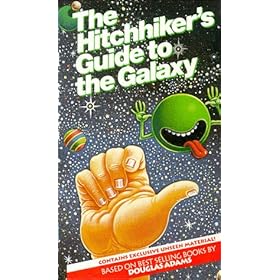
Knock some of the crap off your Christmas list and put this on … the original BBC radio production of Hitchhikers Guide to the Galaxy … trust me, you’ll still be enjoying it long after you’ve traded the summer blockbuster DVD or the lame video game adaptation of the summer blockbuster.

I’ve still got my old cassette version, but you can get it on CD and rip it onto your iPod and be set for life.

Why? Because it’s fun and funny and it’s fun and funny forever. And it’s brilliant, genius, life-changing, smartass, brain-warping, mind-expanding, etc…

If you’ve read Hitchhikers already, you still need this because it’s (a) the same and (b) different. The radio series is the original form of Hitchhikers. This is when “Don’t Panic” was fresh and new.

If you haven’t read Hitchhikers, you need to either (a) read it or (b) listen to this BBC masterpiece immediately.

Why do you “need” to read/listen to a relatively ancient science fiction comedy? ...

Because no one has topped it yet. No one has ever hit this many targets in a row.

A synopsis of the plot is futile, since the plot isn’t the point. I hesitate to say exactly what the point was, but puncturing all known human folly is certainly a byproduct.

If you insist on knowing something about the plot: There are people and a depressed robot flying around in a spaceship. See, as the depressed robot would tell you, that was futile. Perhaps it will help if I add that there are some doors on the spaceship that are very pleased with themselves for opening and closing to allow entry and egress.

Anyway, it doesn’t cost that much and your aunt will be happy to know what to get for you that’s not a gift card or an M rated video game.

If you’ve got more room on your list, here’s a reminder of some titles I’ve talked about before:

Books:
Stanislaw Lem: Cyberiad (Carries my highest possible recommendation.)

Martin Gardner: "The Colossal Book of Mathematics: Classic Puzzles, Paradoxes, and Problems."

Michael Moorcock: “The War Hound and The World’s Pain.”

“Freakonomics.”

Jobe Makar: “Macromedia Flash MX Game Design Demystified”

DVD
Time Bandits

Music
“Sympathy for the Devil” Rolling Stones album: Beggar’s Banquet

Tuesday, November 25, 2008

David Foster Wallace for Christmas


NPR has a list of interesting book recommendations for holiday book buying. A Supposedly Fun Thing I'll Never Do Again: Essays and Arguments by David Foster Wallace caught my eye. Here is what correspondent John McAlley had to say about it:

Despite a staggering intellect and talent that set him apart, the writer David Foster Wallace was by all accounts a determinedly decent and humble everyman. His death this year, at the unbearably young age of 46, was not just an impossible loss to his family and friends, but also to the literary world. For a moment, at least, it felt like the extinguishing of thought itself, and of promise and art and passionate curiosity. For some of us, the only way to salve the sadness was to bathe in Wallace's exuberant writing. Any of his published works would do, but this essential collection of his journalistic pieces — now more than 10 years in print — is particularly alive with laughter and fearless invention. The man burned brightly, and, as gifts go, he gave generously. This season or any other, you couldn't do better than to pass along his flame.

Monday, November 24, 2008

From a guy's POV


Readers familiar with Little Willow's site likely know that she creates lists for all sorts of subjects, formats, genres and just funky ideas that will appeal to certain readers. In particular she has a great list of books for teenage boys with male points of view. To name just a few she thought of, consider the following:

Twisted by Laurie Halse Anderson
Funny Little Monkey by Andrew Auseon
Nothing but the Truth by Avi
Looking for Alaska by John Green
An Abundance of Katherines by John Green
Paper Towns by John Green
Give a Boy a Gun by Todd Strasser
The Rules of Survival by Nancy Werlin
Peeps by Scott Westerfeld
So Yesterday by Scott Westerfeld
I Am the Messenger by Marcus Zusak

This has all gotten me thinking about other books for teens with male POVs something we should be actively keeping track of. (Recent publications would include Cory Doctorow's Little Brother, Neil Gaiman's The Graveyard Book and Sherman Alexie's Absolutely True Story of a Part Time Indian.) (The Gaiman book actually has a younger protag but I think it still works fine for high school readers.)(You tell me if I'm wrong.)

I'm sure we could put together a list if everyone helps us out. To keep from veering into the classics (love Tom Sawyer, but we pretty much all know about Tom Sawyer... :) let's keep the titles contemporary - the 21st century only. That doesn't mean we won't take a look at older books later, but for now give me the best books in the past eight years with teenage male POV.

Friday, November 21, 2008

Slam

Nick Hornby's first venture into YA fiction is the story of a 15-year old skateboarding-crazy teen, whose life is just starting to look up when his girlfriend gets pregnant and everything comes crashing down faster than you can say frontside alley-oop. Slam follows an ordinary guy on a journey he never planned, into territory that's intense, sometimes hilarious and as real as it gets.

I'd been thinking about reading Slam for months, since I'm a huge fan of Hornby's other work (High Fidelity, About a Boy, How to Be Good, A Long Way Down). I admire how he manages to create stories about everyday people that are compelling and thought-provoking. I've always thought his books should come with a warning somewhere on the back cover: Attention: Story inside is deeper than it appears. Hornby makes me appreciate the drama of ordinary life. This said, I admit I was a tad put off by the premise of his first YA novel. After all, there are plenty of books out there already that explore teen pregnancy. I had to wonder, couldn't he come up with something a little more unexpected? I was worried that this book would veer into territory that's been done and then some.

Oh Nick. I should never have doubted you. Forgive me?


Of course, the fact that this novel looks at teen pregnancy from the guy's perspective is something a little bit different. One of the real strengths of this book is the way Hornby gets readers inside Sam's head straight off, and keeps you there, caring about this character all the way along, even when he's acting like a jerk (or perhaps just a confused and freaked out kid). The voice is so conversational and honest that you almost feel like you're sitting across the table from Sam sharing some chips while he tells you about his life so far. I love that.

Skateboarding takes centre stage in Sam's life for most of the book. He idolizes the legendary skater, Tony Hawk, and looks to him for advice and wisdom whenever things get rough. Skating is practically Sam's whole world until he meets Alicia and gets caught up in their relationship. Slowly Sam begins to trust his own judgment and strength as he moves towards the scary responsibility of fatherhood, away from being just another kid at the skate park. Hornby captures this transformation, with all of its bumps and wipe-outs, so convincingly and with great sensitivity.

I suppose you could say that this is a "feel good story," which makes it vintage Hornby, and I guess that also makes it different from a lot of the YA novels out there about teen pregnancy. It's about people making choices that aren't easy, and finding good where they can and living with the hard parts life serves up. At no point was I thinking, "It would never turn out like that in the real world." Slam is never moralistic or sentimental. It's the story of one choice, unflinching and complicated, but with a little room for some kind of "happily ever after."

So pick it up - and while you're at it, grab all the rest of Hornby's books too.

Thursday, November 20, 2008

Martin Millar on werewolves and Led Zeppelin


Martin Millar's Good Fairies of New York has received no small amount of cult-like status among fantasy readers (including an introduction by Neil Gaiman to its recent Soft Skull edition). I discovered Millar through his werewolf novel, Lonely Werewolf Girl which manages to be as much about a dysfunctional family and loving Sabrina the Teenage Witch as much as it is about werewolves. Here is a bit of my review from my July column:

Millar has done more for the urban fantasy genre with Lonely Werewolf Girl than most authors. He lifts the entire oeuvre of werewolf stories up, in a manner similar to what Joss Whedon has done for vampires. There is far, far more here than killing, although Millar never shies away from realistic violence. But when he introduces Kalix’s older sister as a fashion designer he then spins out a subplot concerning the theft of fashion design and gives it a fantasy element. Her cousins are alcoholic pop singers who can’t hold it together long enough to carve out decent careers and Millar takes part of the plot into their hopes, dreams and addictions. Politics, both in Kalix’s dysfunctional family and the larger werewolf world, are key to the story and the author makes that as exciting as one of Kalix’s many desperate chases through the city. Every detail in this book is rich and deep and thoughtful; Millar gives his characters the time and attention they deserve and because of that, readers finds themselves with far more story then werewolf fans have come to expect.

Martin's latest title, Suzy Led Zeppelin and Me, is an autobiographical novel about Led Zeppelin's 1972 concert in Glasgow and teenage crushes, battling with best friends and what it means to be cool. (As it jumps back and forth in time there's also a bit about being a modern literary fiction judge which will likely make many writers shake their heads and pronounce "I knew it!!"). I am reviewing that book next month but here is some of what Jenny Davidson had to say in August:

It is a work of utter genius and considerable grim hilarity, so that I was laughing out loud as often as every couple of pages. It is a short book, composed in short chapters, about the weeks leading up to the night of the 4th of December, 1972, when Led Zeppelin came to play in Glasgow. Martin Millar is just as funny as Charlie Williams and Cintra Wilson, my two other particularly favorite not-as-widely-read-as-they-should-be funny novelists.


Here are some thoughts from Martin Millar he forwarded my way in the past month.

Chasing Ray: Lonely Werewolf Girl is a big book. Did you plan in the beginning to write an epic about werewolves (everything from politics to romance to music to the ripping off of arms) or did the book’s overall narrative expand as you got deeper into it?

MM: I didn’t expect it to be such a long book; it just seemed to evolve that way. I think that’s probably due to the number of relations Kalix has. She’s a member of a large clan of werewolves. It was quite surprising, finding myself writing such a long book. My previous works have tended to be short.

CR: I know you’re a big fan of Buffy the Vampire Slayer – any aspects of the show that affected how you wrote about the MacRinnalchs? Also, what audience were you think of when you wrote Lonely Werewolf Girl? I reviewed it for teens but as an adult I enjoyed it a lot as well. It seems to crossover perfectly (just as Buffy does). Is it hard to create characters that appeal to both teens and adults?

MM: About teens and young adults - I never intended to write for a specific market. After enjoying Buffy the Vampire Slayer so much, I thought I'd like to write something which shared the same sort of general tone. And also, in a way, the tone of various comics I used to read.

So, for instance, there aren't any explicit sex scenes in the book, but that's not because I meant the book to be aimed at a specific audience, it's because an explicit sex scene wouldn't fit in with the tone of the book.

I'm quite happy for Lonely Werewolf Girl to be seen as a Young Adult book - because I seem to be a fan of this sort of thing myself - but I really didn't write it with that in mind. I expected adults to enjoy it too.

Possibly the distinction between Adult/Young Adult has become blurred to an extent where it isn't that important any more. Certainly, if I'd attempted to add any specifically 'adult' scenes to Lonely Werewolf Girl, it wouldn't have improved the book, it would have made it worse. The tone would have been spoiled, all the different strands wouldn't have fitted together properly, and it wouldn't have been believable.

CR: Kalix is not an obviously sympathetic character; in fact for most of the book she reads as more bipolar then you would expect (even for a werewolf). Was it hard not to write about the teen protag as a victim? How did you envision her from the very beginning?

MM: Poor Kalix has a lot of problems, though her highs and lows tend to arrive via anxiety and depression, rather than being strictly bi-polar. Many of the things the unfortunate young werewolf suffers from have been taken from my real-life experiences. From myself and from people I’ve known. Her eating problems and her self-abuse are based quite directly on people I’ve known, as is her depression and anxiety, and panic. Speaking personally, while I’m not prone to depression, I have suffered badly from anxiety at times in my life.

Writing about Kalix, I felt very sympathetic towards her. I didn’t regard her entirely as a victim, because she does have the power to take control of her life at times. When things really get tough, she has the willpower to come through it, just about. As for how sympathetic readers would be, that’s always hard to tell. Possibly I like her more than a lot of readers might.

CR: There is a ton of humor in this book – a lot more than readers have a right to expect compared to most of the urban fantasy out there. How much of this (from Sabrina the Teenage Witch to some major fashion insanity) did you plan ahead of time? Were you always intending to balance the violence with laughter or did some of the characters (such as Kalix) just evolve that way as time went by?

MM: You’re giving me too much credit for planning. I’m a terrible planner when it comes to writing, and always have been. However, I did set out to write Lonely Werewolf Girl with quite a specific tone in mind, and that was always going to involve humour. I think in general I find it difficult to write without being humorous to some degree.

Agrivex, or Vex, is really a character straight out of an American teen comedy. I have, for some time, been a fan of American teen comedies (This may be unusual for a British author of my age) I think this started with the film ‘Clueless’, which the first time I saw it, affected me quite a lot. I was very impressed that anyone could make such a sharp, funny film, using a Jane Austen story as the source (I am a great fan of Jane Austen, though I have never attempted to emulate her style, obviously.)

Queen Malveria is another humorous character. However, I don’t know where the inspiration for her came from, she’s not based on any other character I’ve encountered.

CR: What aspects of the story did you enjoy writing the most – the political maneuverings, the fashion crisis, the music crisis, the coming-of-age moments and friendships or the cut-throat violence? And how hard was it to bring all of this together into one story? Did you ever worry that there were too many threads or do you think maybe we (as readers) just aren’t used to reading books that combine so many characters into one coherent (and thrilling) tale?

MM: That’s difficult to say. I’m not sure what I enjoyed writing the most. I like writing anything about Kalix, because I like her, and apart from that, probably the scenes between Malveria and Vex. I liked writing about Thrix and Malveria and their fashion obsessions, though that was difficult because although I sympathise with people who are very keen on fashion, I don’t actually know anything about it. So really I was relying on copies of Vogue bought from the local newsagent.

As for the werewolf violence, I quite liked writing that too. (I wouldn’t say it was on a very high level – I’m not fond of gore or horror) It made for a change. I’ve never written about fighting before but possibly, having read a lot of comics as a youth, I had a secret desire to do so.

I wasn’t worried about including a lot of different threads. I thought that they were related enough for people to follow. Though there are a lot of characters, most of the story is driven by the feud about the succession to the leadership of the werewolf clan, so it’s all going in the same direction. As for the balance of the book, with its humorous parts and serious/violent parts, I have the general feeling that if you write these parts all properly, they should fit together well enough.

CR: Switching gears a bit, Suzy, Led Zeppelin and Me reads more as a memoir than novel in a lot of ways – could we call it a fictionalized memoir? How much of your own story (past and present) is found in the book?

MM: Most of the significant events in the book are true, so in that way it’s a memoir. However, I re-arranged them all, added in pieces of fiction, and I had no qualms about shuffling events, places and times around to make it into a better story. So I think of it as a novel rather than a memoir.

CR: How much do you think we bond with the music of our youth? In a lot of ways you’re written an entire book around this subject – how significant do you think music can be over the course of someone’s life. (Or in other words – is it more important during the turbulent teen years than to adults?)

MM: We definitely bond with it. When I was a teenager there was nothing so important in my life as music. Actually, that lasted beyond my teenage years, though it’s faded a little now, which is natural as you get older. New music doesn’t resonate in the same way, and you find yourself more attached to the music you’ve always loved.

I regret this in a way. It would be good to hear some new music now and think ‘This is fantastic! It’s changing my life!’ But that doesn’t seem to be possible when you get older. Shame really.

However, when you do get older, and find yourself keener on the music from your youth than the music that people are listening to today, you should take care not to assume that the music you love is somehow better. It’s not necessarily better, it’s just that it means more to you.

CR: Part of what really appealed to me about Suzy was that it seemed like the ultimate coming-of-age story. Readers bond with Martin as he struggles with first love, fragile friendships and significant relationships and then see, basically, how he ended up. Is this sort of the ultimate (and most realistic) sort of coming-of-age story – one that does not stop with a moment of teen awareness but continues right through to adult nostalgia?

MM: I needed to find some way to write about my extreme excitement at the thought of Led Zeppelin coming to town, but I was too aware of how life went on afterwards to end it like that. So I wrote it from the viewpoint of an older person looking back, and that naturally took the story on after his coming of age moment. Possibly, if I’d been writing about some fictional characters, I’d have let them just end happily at the Led Zeppelin concert. I’m not against a happy ending, even if life isn’t really like that!

From my own point of view, it was interesting looking back in detail at the concert, and my life at the time. I got in touch with various school friends, asking what they remembered about the gig, and I learned a lot of details I’d forgotten. Also, to my amazement, I found a bootleg CD of the actual gig, which I bought from Japan. I was astonished that a recording of this concert in Glasgow in 1972 existed, and it was strange listening to the concert again, and thinking about being there, such a long time ago.

CR: So what sort of book do you prefer writing – the big sweeping epic with a dozen main characters and confrontations or the short chapters in a tightly focused story about one singular event in the narrator’s life?

MM: Short books. I said In Suzy, Led Zeppelin and Me that I have a short attention span these days and it’s true. My attention span has been destroyed by cable TV and the internet, no doubt. I can offer no cogent explanation as to why I suddenly wrote something as long as Lonely Werewolf Girl. And, as I'm writing a sequel now, I’m doing it again. But I have vague plans for my next book after LWG 2, and that will almost certainly be short.

Cross posted at Chasing Ray.