Friday, October 31, 2008

"The Skull Of Truth" by Bruce Coville - Cemeteries, Magic, and Creepy Fun!


Charlie has a problem with the truth. Nobody believes him anyway, so he's gotten used to lying all the time. And while he's no thief, when he sees the skull in Mr. S.H. Elives' Magic Shop, he's compelled to swipe it.

Turns out it's not just any skull... It talks to Charlie in his head, tells jokes, and oh, yeah...

it's cursed.


The curse forces Charlie, and anyone near the skull, to tell the truth. What do I mean?

Like everyone in his family revealing they hate his aunt Hilda's green Jell-O and cottage cheese salad.

Like family secrets about his Mom and his favorite Uncle Bennie that were in hiding and are now blurted out.

Like mortifying Charlie himself when his best friend, Gilbert, who has lost all his hair to cancer treatments, asks Charlie if he really looks that bad and Charlie answers truthfully:

"I think it looks totally doofy," he said. "And I hope to God it never happens to me."


This stupid Skull of Truth is ruining Charlie's life. And it won't shut up!

But maybe there's a way Charlie can fix things with Gilbert, deal with the bully Mark, and even stop developers from paving over the swamp he loves... If he can just figure out what to do with the truth!

I really loved this middle grade book - it's spooky without being completely scary, and for a book with a lot of laughs and thrills, Charlie has a huge heart and we really want him to figure it all out. Even the "villains" are three dimensional, and nothing's quite as good or evil as Charlie thinks it is at the beginning of his journey.

There's also a subplot about Charlie finding out that an adult in his life is gay. It's a shock for him, and his coming to terms with that truth about someone he cares about is handled beautifully.

Truth can be complicated, and after a great fun ride, "The Skull Of Truth" left me with lots to think about.

Happy Halloween from everyone at Guys Lit Wire!


Thursday, October 30, 2008

Kelly LInk's surreal "Pretty Monsters"


I've been a fan of Kelly Link's for quite some time and was quite pleased to see her new YA collection, Pretty Monsters. Including stories published in various publications over the past few years plus the new titles story, this collection should introduce a whole new group of readers to Link's incredibly unusual way of seeing the world. Here's a bit of my review from the current issue of Bookslut:

There are several standouts for me in Pretty Monsters starting with the first story, “The Wrong Grave.” Riffing on the true story of Dante Gabriel Rossetti and Elizabeth Siddal, Link references everything from Buffy to Survivor as she writes about Miles Sperry who decided to dig up his dead girlfriend and recover some poems he had melodramatically buried with her (they were the only copies of course). Miles digs up the wrong girl and finds himself instead with “Gloria” who is not at all like the dead Bethany and not interested in Miles's reasons for disturbing her peace. Gloria has been a bit bored it seems and Miles becomes her new diversion -- no matter how hard he tries to get away. It seems a cliché to say the ending is a shocker, but it is and it is splendid and Gloria is pretty much my new ghost hero.

“The Specialist’s Hat” has gained a lot of attention for its spin on babysitters with bedtime stories and still manages to creep me out every single time I read it. (Knowing what will happen next in this one does not diminish it -- if anything the tension builds even more in anticipation of the final page.) “Magic for Beginners” defies expectations and assumptions every step of the way as it follows teenage fans of an unscheduled unexplainable television show who group together to discuss its every twist and turn. The fact that the story’s plot also involves a phone booth bequeathed to the main character and a love triangle (or more) makes it both odd and typical. This is coming-of-age of the decidedly Addams Familyesque kind but crossed as well with a healthy dose of X-Files paranoia. Smart and snappy, “Magic for Beginners” is one of my all-time favorite short stories.


If you are a fan of stories with a twist then you need to read Kelly Link. She's in a class of her own and offers a startling new way to both write and enjoy a good story.

Wednesday, October 29, 2008

Helen Hemphill

To date, Helen Hemphill has released three novels, two of which have had male protagonists. When we spoke earlier this month, I asked her how she felt about writing for guys and writing from a male perspective.

Do you approach your stories differently depending on the gender of your protagonist?

I don't really have a different approach if I write across gender. When I worked on Long Gone Daddy, I checked in with the Gender Genie occasionally to make sure I was on track for a male voice, but I haven't done that recently. Given a text sample, Gender Genie uses a simplified algorithm to predict the gender of the writer. I used it to make sure the narrative of Long Gone Daddy was masculine in its feel and perception. Now, I really do try to be in the character's mind set, using some of the techniques of Uta Hagan's book Respect for Acting. Once I am grounding in the voice, I don't worry as much about the gender; it just comes along naturally.


Do you feel comfortable writing a male voice? or: What are the challenges you face when writing in a male voice - and/or writing for boys?

I do feel comfortable writing a male voice. I have two [now adult] sons of my own, and I think my own personality is to be rather straightforward, so both of those things help. The challenges are clearly in word choice, and I began using a vocabulary journal while writing Runaround. The other difference is emotional reaction. Boys react differently to emotional upheaval; they can be more restrained or more angry when emotional events happen. I try to be aware of that and sensitive to it.

Your second novel, Runaround, was the story of young girl named Sassy growing up in the sixties. Do you feel as though there are 'girl books' and 'boy books?' Do you, like me, want to break that division or assumptions?

I don't know if that's totally possible. I'd love to believe that there are just good stories, and gender doesn't play a role in a reader's selection of text, but I do think boys are drawn to certain kinds of stories and girls are drawn to certain kinds of stories. As adults, I just think we should honor young reader's choices and not try to push one direction or another. Good readers eventually branch out and read lots of different kinds of material, and that's what we all ultimately want children to do.

Do you prefer to write in first-person or third-person? Is that decision influenced by the gender of your protagonist?

I don't have a preference; it's just how I hear that particular voice. Gender doesn't play a part either. I think it's some bigger aspect of the story I'm trying to tell. How close do I need to be to that protagonist and how limited I'm willing to be in vocabulary are factors, but that's part of the larger structure of the story.

What compels you to write historical fiction? What compels you to write contemporary fiction?

Again, it's the story. If I'm attracted to the premise of the story so much that I have to work on it, then it doesn't matter what the time frame or the landscape of the novel. It's all about story.

Give us a preview of your new book, The Adventurous Deeds of Deadwood Jones.

It's a wild ride adventure story for boys about two cousins, Prometheus Jones and Omer Lovejoy Shine who head west to find opportunity and to look for Prometheus's father. Like most of the cowboys of the real west, the boys are young, 14 and 11, and have to face the hardships of living on the land while working a cattle drive. The unique aspect of this story is that the boys are African American, and they find the west a genuine place of opportunity, where a man is judged on his ability. That doesn't mean they don't find prejudice as well, but the cattle drive allows the boys to test their grit and learn about themselves.

What inspired you to write Adventures?

I read Nat Love's autobiography a couple of years ago and loved his bravado voice. Nat was an African-American cowboy who was born in Nashville at the end of the Civil War and went west to find his fortune. Nat was the best at everything - the best shot, the best wrangler, the best cowhand - and I was inspired to write a story about a boy who was like Nat, yet also different from him. There was also a wonderful opportunity to write about one of the 5,000 African American cowboys who worked the cattle drives in the late 1800s. The contributions of those Americans were a story that hadn't been told widely, and I thought it was important. Plus, who wouldn't want to write an adventure story about cowboys? It was fun!

When your sons were little, what were their favorite books?

When they were little, they were fond of Mr. Popper's Penquins, the mysteries of Cynthia DeFelice, and Sports Illustrated for Kids. As teens, they both jumped right into adult fiction. My youngest son Michael is a huge fan of Harper Lee's To Kill a Mockingbird and Mario Puzo's The Godfather. Our oldest Robert loves nonfiction sports books, most recently Carl Hiaasen's The Downhill Lie: A Hacker's Return to a Ruinous Sport.

----

The Adventurous Deeds of Deadwood Jones will hit stores in November 2008.

Read my 2007 interview with Helen Hemphill.

Visit the author's website.

Tuesday, October 28, 2008

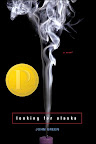
Looking for Alaska by John Green

Looking for Alaska made me think about death, and what happens after we die. And it made me think about the ways in which emotional pain can be as deadly as physical pain. It made me think about my friend who studies religion and has expressed some of the same ideas as Green (who also studied religion). It also made me think about belonging, and what it meant to me as a teen, and what it means to teens I know. It made me think about what, exactly, home is.


The narrator is Miles, a high school junior, who goes away to boarding school. There, he meets a group of friends, the first group of friends he's had in his life. In his old school he was an outcast, but the sense of belonging he feels at this new school triggers a lot of growth in him. This reminded me of a boy I know, who was an outcast in his previous school, but is now thriving, with a group he belongs to, in a different school. Sometimes small changes can change an entire life.

Miles' group of friends is what many parents would consider "the wrong crowd."


But for Miles, it's the right crowd, because although they introduce him to "booze and mischief" as well as smoking and sex, all of which contribute to the constant threat of expulsion dangling over their heads, they understand him. They look at him, and they see Miles, who he really is, and they accept him. This matters so much more to him than whether the people who include him are "good kids" or "bad kids."

The sun around which the rest of the group revolves is Alaska, a girl with so much charisma that everyone seems to be at least a little bit in love with her. Alaska is impulsive and reckless, as well as troubled, and she barely shares the source of those troubles with her closest friends. In the end, knowing Alaska is the greatest source of pain Miles has encountered in his life, but it's also a catalyst for his personal growth, for him to start forming his own values and viewpoints and interests, beyond the main interest he arrived at the school with: last words of famous people.

I really can not recommend this book strongly enough. I've found a new favorite writer.

Here's a videoletter to his brother that Green made when Looking for Alaska was being challenged. It is the best censorship rant ever.


"The books that the world calls immoral are the books that show the world its own shame." Oscar Wilde

Monday, October 27, 2008

Sunday, October 26, 2008

Teen Screen 101


It's been a while since I've run across a book that leaves me running hot and cold depending on my mood when I pick it up. On the one hand what we have is a thorough course in film media awareness, a textbook for exploration of writing for television and film; On the other hand the aim seems to be driven toward raising an army of teen screenwriters armed with the skills to keep turning out the same sort of studio drivel that has been cranked out for decades now. In the end I find myself forced to admit that had this book been around when I was a teen I would have owned it and probably would have been a different writer as a result, for better or worse I couldn't say.

Screenwriting for Teens presents each of the principles on the right side page with a clear explanation and examples. Flip the page and there is a "look and learn" segment recommending films, TV shows, and even commercials that support the principle at hand. There's also a "brainstorming" section that provides three different exercises to reinforce the lesson and provide young readers with a broader background in understand how to write.

The book opens with a lesson on the differentiation between books and movies, with a brief study of classic story structure, and quickly builds up to short studies on cinematic structure and the Hollywood method for developing a marketable screenplay. In these bite-sized segments a young writer will learn much of what is taught in most other books and seminars on screenwriting and it is highly accessible. The examples are, for the most part, well-chosen and the exercises are solid enough even for experienced writers to get something from them.

Where the book falters for me is how it seems to go out of its way to not look like a textbook or something equally formidable, but in doing so treats the serious student too casually. "If you're not already keeping a daily journal, start one" seems like something that should come at the beginning of the book and not as an aside eight chapters in. Additionally, there is an unspoken assumption that the reader has an endless amount of time and access to watching television shows and movies without really letting the budding writer know what they're getting into. Granted, the serious student will devour these assignments and hunt down whatever looks interesting to them, but just as many might find the task daunting part way through and be tempted to give up.

With the ever-changing television line-ups and cultural phenomena there are references to television shows no longer on the air, as well as films that even most film students in college have never seen. And very quickly it becomes clear that this is a book that one cannot breeze through in a month or even a few months. Watching the recommended films and programs, following through on the activities will take time. What Hamlett hasn't also adequately prepared the budding screenwriter with is a lesson in patience.

Yet, I still like what this book does. It says to the teenage screenwriter "Okay, this is what it's all about" and plows ahead with its challenge to keep up. Those who think that writing for television or movies is a shortcut to fame will quickly learn that the modern screenwriter's craft is no less arduous than any other writer's. Serious teens who believe this is truly their destiny should make this a first test of their strength and endurance. This would only be a first stop because there is much more about character and scene development that a solid screenwriter needs to know and should learn from other books on the craft. Syd Field's books, and Robert McKee's Story and, just to get some perspective from a master in the field, William Goldman's
Adventures in the Screen Trade, to name a few of the better ones.

For the first-timer, the student looking to make solid short films and develop themselves as screenwriters, Hamlett's book is a step in the right direction.

Screenwriting for Teens
The 100 Principles of Screenwriting Every Budding Writer Must Know
by Christina Hamlett
Michael Wiese Productions 2006

also mentioned:
Story: Substance, Structure, Style, and the Principles of Screenwriting
William McKee

Adventures in the Screen Trade
by William Goldman

Screenplay: The Foundations of Screenwriting
and
The Screenwriter's Workbook

both by Syd Field

Saturday, October 25, 2008

David Almond blogging Day 2

Or: "What's there to be afraid of? It's only in your head..."

Last week*, I ended by admitting that there is something frightening about David Almond's books, something powerful and dark and mysterious. It's this very quality, his ability to turn a world we accept without thinking into a stark and terrible truth simply by exposing it to the power of imagination, that I find so compelling in his work.

Okay, so what does that mean? Well, I think Almond's books fall into two types (if I can be so crass as to bluntly categorize one man's entire body of work), and Skellig, his first book and the one I discussed last time, falls into the first category, in which Almond explores what is frightening about the world around us, and how we triumph over that fear with imagination.

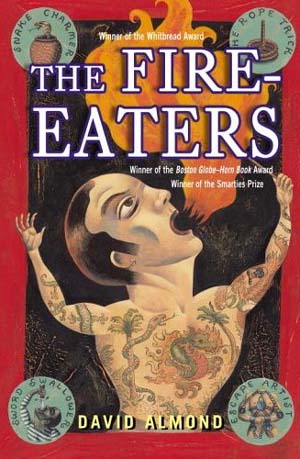
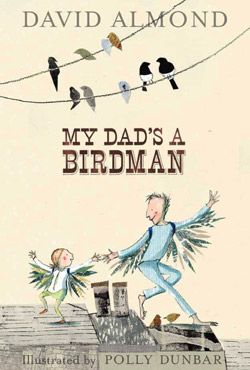
Maybe I'm wrong about this, but if you look at books like The Fire Eaters (one of my personal favorites), My Dad's a Birdman, Skellig, and his latest, The Savage, you find a core conflict at work: individual kids struggling with threats--ominous, nebulous--threats and fears encroaching from the outside world. And their struggle is as much one of imagination as it is something concrete.

As imperfect a choice as it may be, I use that word "concrete" to avoid the word "real", because in a David Almond novel, questions about what is real and what is not are almost not worth asking--the mind is powerful enough to conjure both angels and demons, and sometimes, as with Skellig, it is unclear which is which.

All this is nebulous, so let me give an example. His chapter book, My Dad's a Birdman, is often overlooked because it is aimed at younger readers, however, in many ways, it's the best place to stare. What I'm talking about is quite clear at the outset. The main character, Lizzie, is motherless, and her father is nearly useless, pretending he's a birdman, requiring Lizzie to cajole him into eating, showering, shaving, etc. The book opens with a scene much like most schoolday mornings: a parent pushing, arguing, prodding their kid to get ready for school. Only here it is not the parent doing the prodding, but the child, and it is not a kid that resists getting ready and getting on with their day, but the father.

I'm in the middle of reading this book to my 5 year old daughter, and I could tell from the beginning that she was riveted by it, caught somewhere between excitement and unease. Within its pages, the natural order of the world is upended: everythings is reversed--a child is responsible for an adult, and a parent acts out, playing pretend and ignoring the rules of what should be. My daughter finds it strange, funny, and disturbing all at the same time. She's hooked.

Imagination, then, both transforms and violates, through its ability to take off in flight (I think it's no coincidence that wings play a large role in many of David Almond's novels) and to threaten everything and everyone around. In The Fire Eaters, the book opens with Bobby Burns witnessing a homeless carny named McNulty swallow fire and pierce his flesh with knives. It's a great opening, and very David Almond: vivid and grotesque. But, while Bobby is disturbed by McNulty, there's something about the fire-eater that gets under his skin, that he absorbs and makes his own--which then opens the door for Bobby to confront some of the more personal demons (an oppressive new school, a growing distance from his best friend) that come up in the novel through his own defiant, sensational, and disturbing actions.

But there's another kind of David Almond novel, one in which the disturbing swirl of the darkest substance a young mind can conjure creates a world all its own, outside the influence of the orderly world of adults. And that, for me, is the best Almond has to offer--and I explore that more in my next David Almond blog (hopefully much less than a week away...)

*btw: sorry it's taken me so long to get this follow-up post on here--I've been waylaid by illness, but am feeling much better now.
(edited to add links)

Friday, October 24, 2008

So you want to rule the (Under) World?


Please allow me to introduce myself
I'm a man of wealth and taste
I've been around for a long, long year
Stole many a man's soul and faith
-Rolling Stones’ “Sympathy for the Devil”


The devil’s been making appearances in books for a long, long time -- I.e., the Bible -- but I’m not sure anybody’s every nailed the character like Neil Gaiman does in the Sandman graphic novels.

One of the challenges of a comic book is making you scared for the main character. When’s the last time you were really scared for Wolverine? But when The Sandman, who is a powerful man after all, goes to Hell in “Season of Mists” it really is scary, because Gaiman’s Lucifer is so very bad.

But the book I really want to talk about here presents the other side of Lucifer altogether. What if he was good? What if he wanted to make the world a better place? Really. No tricks. He wants to help. Would you help Satan?


Our hero, Captain Von Bek, is a warrior, a real Medeival bad ass. They call him “Kreighund” or “The War Hound.” He’s no devil worshipper, but he becomes entangled with the Evil One. Whereupon Satan escorts Von Bek to Hell and explains his problem.

The Lord of Hell has been Lord of Hell for a long, long time, ever since he was thrown out of heaven. He had been an angel and now he’s a rather bored keeper of the flames of torment.

Satan: “I am weary of the Earth and still more weary of hell, captain. I yearn for my position in Heaven.”
Von Bek: “But if Your Majesty is truly repentant…”
Satan: “It must be proved. I must make amends.”


But how do you make amends to God, when he threw you out and has been ignoring you for millenia? You need to make a big gesture, right? And Satan has decided that his gesture will be finding the Cure for the World’s Pain. And, for reasons too complicated to go into now, he needs Captain Von Bek’s help to do it.

This book is “The War Hound and The World’s Pain,” by Michael Moorcock. It’s intellectually challenging sword and sorcery and the ending is stranger still and may require you to rethink your world view.

As for the author, Michael Moorcock, I can hardly recommend him highly enough. He has many tales of many different flavors, some of which interweave to create the story of the Eternal Champion. The Elric books are a great place to start if you want some really heaby duty sword and sorcery. But if you want to really blow your mind, try An Alien Heat, the first of an amazing series of books about the people who are alive at the End of Time.


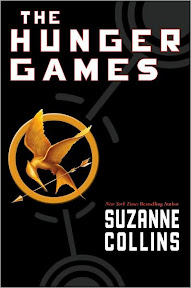
The Hunger Games by Suzanne Collins

Hunger Games book coverReviewed by Steven Wolk.

I have never watched a "reality show." Supernanny, Survivor, Big Brother, Wife Swap, and on and on and on, I’ve never seen one of them. Sure, I’ve caught ten seconds here and there as I flipped channels, but I’ve never parked myself on a couch and flipped one on. The fact is, I don’t watch much TV, but reality shows take my disdain significantly further. I just don’t like the idea of the shows. And besides, there isn't much "reality" in reality TV, but a manufactured reality. They are, after all, a TV show. Enter The Hunger Games, a dystopian novel (with a dash of sci-fi fantasy) about reality TV – and society – gone amok. I may not like the shows, but I had to read this book. And once you start reading it you will zip through it like the story’s tracker jacker bees, honing in hungrily on a victim. This is a dazzling book that should be devoured by middle and high school kids and adults.

It is the future. The United States is no longer and in its place is Panem, which is divided into twelve districts. Each district focuses on a commodity. While one district does the agriculture another does the coal mining. There is a clear hierarchy to the districts; a class system. Food is scarce; some people choose (illegally) to hunt for food. Rulers in the Capitol, a wealthy and somewhat mysterious epicenter of power, run Panem. Clearly they have a very good life while the people struggle. Each year the rulers host a reality show – The Hunger Games -- that pit people from each district against each other. One boy and one girl – 24 in all -- are selected in a lottery to compete. But there’s a catch. There’s only one winner because in the end, there is only one still alive. That’s right, Jerry Springer is a walk in the park compared to the Hunger Games, where kids from twelve to seventeen fight to the death in a chosen arena – and it’s all a wildly popular TV show. The Hunger Games is, almost needlessly to say, the first book in a trilogy.

Sixteen year-old Katniss lives in District 12, the land of near-destitute coal mining, and immediately volunteers to replace her younger sister in the Hunger Games after she’s selected in the lottery. Katniss has at least one advantage: The arena for this year’s games takes place in a forest, and Kat has become something of an expert hunter to keep her family fed. That’s right, Katniss is a hunter, but now she will have to hunt people – no. make that children – to stay alive. So, right about now you might be thinking how disturbing this sounds. Well, it’s meant to be disturbing.

Out there, roaming the forest, in fear of imminent attack, Katniss is a jumble of emotions and intellect. She is not only a hunter, but she is smart. And she is weighed down by the complex emotions over two boys, Gale, her hunting partner back home, and Peeta, the other District 12 participant in the games she became close to during their pre-games training. Kat knows – and we know – that for her to win Peeta must die. And constantly hovering over her like an ominous cloud that never leaves are the Gamemakers in the Capital, because they are controlling much of what happens in the arena during the games, just like they are using their power -- and entertainment – to control the people of Panem.

Like all great dystopian novels, The Hunger Games may take place in the future, but the story is really about life today. Sure, we’re not watching people slaughter each other on TV, but our nation loves to watch men pound each other in the boxing ring and pay-per-view "Ultimate Fighting" and tune into Maury to witness people scream at each other about a pregnant fifteen year-old, not to mention the endless TV shows and movies focused on pretend violence and our very real wars with their very real violence. So, yes, the book is disturbing and tense and sometimes graphic. But maybe our lives are not all that far from the Hunger Games?

Peeps by Scott Westerfeld

Last week, Shelf Elf pointed out how many vampire books are written for girls. It's true, but my problem with vampire books has been how interchangeable many of them seem. Take a vampire from one book and you could probably plop him or her into another vampire book without making any changes. More than just the pointy teeth or thirst for blood, it's the moody atmosphere, the angst-ridden vampires, and the way they were turned into vampires to begin with. There are exceptions, of course, and of the exceptions, Peeps stands far ahead of the rest, with vampires unlike any I've ever read before.

Meet Cal, who went to New York for a college education but ended up with a lot more. After hooking up with a girl he met at a seedy bar, he became infected with a parasite that he will end up passing on to anyone else he hooks up with.

In a way, Cal is lucky: he’s only a carrier, one of the rare ones, with the enhanced senses and abilities of a parasite positive, or peep, but without any of its other effects, like an aversion to light and craving for blood. Because in Cal’s world, vampirism is an STD caused by a parasite. And he refuses to infect anyone else, which is hard enough when you’re nineteen years old and single, nevermind when you meet a girl you actually want to be with.

Now Cal’s working for the Night Watch, a secret group which has fought vampirism for centuries. He’s tracking down all the girls he inadvertently infected and trying to find the girl who infected him in the first place.

So, like vampire books? Read Peeps. Don’t like vampire books? Read Peeps anyway. It’s a fast-paced, exciting take on vampires by Scott Westerfeld (author of the Uglies series) that will have you on the edge of your seat when you're not squirming with disgust.

Oh, did I not mention all the details about parasites? If you're fascinated by parasites, you're in luck! In each odd-numbered chapter, Cal narrates his story, while relating graphic and often rather gross information about real-life parasites in the even-numbered chapters. The parasite chapters are interesting and don't slow down the story's momentum at all. Combined, these elements plus Westerfeld's storytelling add up to form one creepy story, a vampire book that may actually scare you.