Monday, March 19, 2012

Ultimate X: Origins and Fractured Fables

Two of my favorite comics this year so far are the collected first issues of Ultimate X and the Fractured Fables graphic novel. Ultimate X: Origins is Jeph Loeb's take on the Ultimate Universe where the X-Men are gone and mutants around the world are hiding from authorities. Loeb is well known for his work on television like Heroes, Lost and Smallville. He writes a fast moving story centered on the children of mutants.

Each issue introduces a new character to Ultimate X, while a different observer narrates each story. The series begins Jimmy Hudson's adopted father telling of the hope he had for his family. He narrates,

"We started to build a thirty-footer. Hadn't even thought of a name for her yet. We were going to sail around the world. But then the world changed."

Change happens dramatically in the Hudson family when they are informed that Jimmy is the son of Wolverine and has many of his mutant powers. From there, Jimmy seeks out other X-Men and mutants like Jean Grey and others. It is awesome to see an X-Men team started completely from scratch. This is similar to many other mutant comic stories, but still makes for a fun read and is a great set up for future volumes.

Fractured Fables follows a crazy amount of books and graphic novels dedicated to re-writing classic stories and fairy tales. This collection features over thirty great cartoonists like Doug TenNapel. Little Red Riding Hood by Bryan Talbot wonders what would happen to the wolf when Grandma fights back. Mary Had a Little Lamb turns into Mary Had a Little Spam. TenNapel's offering is a fun take on Rumplestiltskin and what happens after the classic story. Royden Lepp writes about Little Miss Muffet as a bug collector.

As in any collection, the quality varies, but there are many good, funny and twisted stories with bright, vivid artwork.

Friday, March 16, 2012

The Robot Novels by Isaac Asimov

I've been of fan of Isaac Asimov’s fiction for quite some time, probably starting around the time I was in sixth or seventh grade when my brother gave me the last (chronologically) of the Foundation novels, Foundation and Earth. I loved that book and sought out more, even Asimov's short fiction - I'm not usually a fan of short fiction. Sure, I found some of the older stuff quite dated - even quaint. But even the outdated material often had a great story and interesting characters (not all the time, nobody's perfect). But as a whole, Asimov's fiction pretty much started me on the path to my love of written science fiction.

Recently finding myself with nothing new I wanted to read, plus a desire to not sit in front of computer in my down-time as I often find myself doing, I went looking on my bookshelves for something to re-read. Spotting my shelf of Asimov books, I considered for a moment, then decided to start "at the beginning" of the future history with the Robot novels.

Thursday, March 15, 2012

Diary of a Mosquito Abatement Man by John Porcellino


The above comic is by John Porcellino. I wanted to start with it just because I think the man and his art stand on its own -- but read on and delve deeper into this cartoonist whose art carves deep into the experience of living.

Wednesday, March 14, 2012

Soldier Bear

Only warfare could create a story so improbable.

During World War II as Russia and Germany fight to claim Poland for their own the citizens caught in the middle are taken as prisoners in their own country, forced to flee to neighboring Iran. Among these escaped expatriates are Stanislav and Peter, a pair of inseparable friends who agree to join the British in the fight to help reclaim their homeland. One day while stopped along the road they spy a starving young boy with nothing to trade the soldiers but a small sack containing a bear cub. A cute little bear cub, who so totally entrances Peter that he trades a pocket knife, some cash, and tin of meat for it. None of the soldiers of the 2nd Polish Corps would imagine that this cute little pet would become not just a mascot but a source of comfort and a valuable comrade in the fight.

Once weened from milk the bear they named Voytek, "smiling warrior" in Polish, quickly adapts to his surroundings and behave much like a small child in the camp. Voytek prefers to sleep with Peter instead of his little makeshift bed, he bothers the cook for scraps, and learns how to give himself showers in the heat of the Palestinian desert where they are based before moving closer to the front. When scolded or scared Voytek covers his eyes with his paws and rocks back and forth, and when the soldiers become melancholy he knows to stand on his hind legs and place a reassuring arm on a man's shoulders. Raised around men Voytek learns how to behave as a man, as much as a bear can without betraying his nature. Granted, the soldiers introduce the bear to beer, which he loves and can be bribed with, and he mimics the soldiers smoking by stealing their lit cigarettes and eating them, but he also pitches in and carries ammunition when its time to work, earning Voytek an official designation as a Private in the 2nd Polish Corps.

Tuesday, March 13, 2012

Baby's In Black by Arne Bellstorf

Coming soon to a bookstore near you: Baby's in Black: Astrid Kirchher, Stuart Sutcliffe, and The Beatles is a hardcover graphic novel about the early days of one of the best-known bands in the history of the world.

You see, once upon a time, in the early 1960s, the Fab Four was in fact a band of five: John Lennon (guitar), Paul McCartney (piano and guitar), George Harrison (guitar), Pete Best (drums) and Stu Sutcliffe (bass), and they were playing at clubs in Hamburg, Germany. A young German guy named Klaus Voormann was one of their earliest fans, and he brought his ex-girlfriend, Astrid Kirchherr, to see them. Klaus and Astrid eventually met the band, and, as the end note in the book indicates, Klaus maintained his friendships with John, Paul, George - eventually living with some of them, and performing with others. But although some of Klaus's story is woven throughout this book, it truly tells the story of Astrid Kirchherr's real-life romance with Stuart Sutcliffe.

Monday, March 12, 2012

Draw the Dark--Ilsa Bick


As I read Ilsa Bick’s Draw the Dark, I started thinking back to my days as an obsessive X-Files fan. Episodes either advanced the show’s increasingly complex mythology, or they were standalone, “Freak of the Week” episodes. These self-contained episodes commonly featured adults or teens with paranormal abilities, abilities that they often could not control and that led to increasing isolation. I thought of these episodes because the story of Christian Cage (metaphor alert!) in Draw the Dark would have made an excellent standalone X-Files episode, what with its discussion of telepathy, conduits, and conspiracy.

Friday, March 9, 2012

We the Animals by Justin Torres

We The Animals, Justin Torres’s 2011 debut novel tracing the narrator’s emergence into adolescences in rural upstate New York, reveals a captivating voice and a perceptive eye to the conflict and pain that lie below the surface excitement of growing up.

Torres successfully situates the first-person narration in the growth from a child’s naiveté to the beginning inchoate grasp of the world’s harder realities. With the narrator at the tail end of childhood, he doesn’t condescend or work in a fake child-like idiom, but takes in the wild adventures of three brothers in the same curious view as he does a tumultuous home life. Judgment is rendered only as to immediate pleasure or pain. As the character ages, Torres lends him a more critical eye, but never steps outside his adolescent subjectivity.

Wednesday, March 7, 2012

Why We Broke Up by Daniel Handler and Maira Kalman

Another teen novel in which an ordinary girl finds herself in a relationship with the school basketball star, despite their differences. Ho hum.

What’s that you say? Why We Broke Up was written by Daniel Handler? The man what created Lemony Snicket? And with paintings by the always-excellent Maira Kalman? AND it won a Printz Honor? Huh, this might be worth checking out after all…

So I did. And I’m afraid to say that I was mildly disappointed.

Tuesday, March 6, 2012

Await Your Reply

Ryan's hand has been severed. His father is driving him to the hospital, or so he says, the hand on ice between. This is the opening image of Dan Chaon's Await Your Reply and it's only one of the many chilling horrors you'll find in its pages.

The book is made up of three parallel story lines. In one, Ryan has left his adopted family and a failing college career, unintentionally faking his own death in the process, to take up residence with his biological father, a small time con man. In another, nineteen year-old Lucy, flees her small-minded Ohio town with her former high school history teacher, George Orson, who promises to make them both rich through some nefarious dealing. In the third, Miles takes a leave of absence from his job with a Cleveland-based magician's supply company to go chase down his identical twin brother Hayden in Canada. The conspiracy-obsessed Hayden, the only family Miles has left, has been diagnosed with schizophrenia and escaped, years ago, from the institution which was treating him.

Monday, March 5, 2012

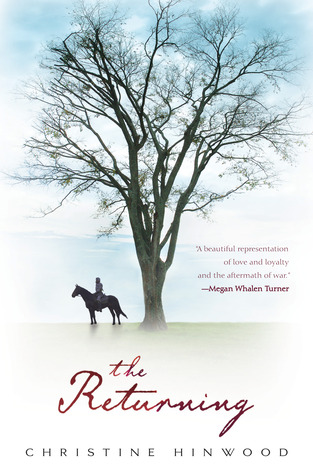
The Returning by Christine Hinwood

As a longtime reader of fantasy novels (and even as a shorttime reader, in my younger days) there comes a point where the generic conception of fantasy simply doesn't cut it all the time. Kingdoms warring with Earth-Shattering Consequences™, plucky young protagonists who have destinies to save the world, and full of grand-scope epic detail, the kind of fantasy Diana Wynne Jones aptly and lovingly skewered in The Tough Guide to Fantasyland—it can get tiring after a while.

Fortunately, not all fantasy deals with matters of global import; quite a few are decidedly provincial, and Christine Hinwood's The Returning is among them. It's not even ultimately a novel about war and conflict (something that even other smaller-scale fantasies miss)—the story does start a short time after Cam Attling returns from the war as the only survivor of his small village, but it's not about the war. It is instead about the aftermath, about growing older and changing, getting lost and finding yourself in unexpected places; that it happened after a devastating war is almost unimportant.