Robots that come to life is a story that's been around since Asimov wrote about them in the '30s, and before that too, probably, I'm no historian. That doesn't mean that every once in a while a story about androids and their human masters can't come along and take you on a really cool ride. Enter Alex + Ada, a story that demands your attention and keeps it to the very last page.
It's the near future, flying robots make your breakfast and you do all of your shopping, net browsing and socializing via a chip that you have implanted into the side of your head. It's like having Amazon.com as your sub-conscious, fun!
Our titular character Alex is depressed, he's still not over the girl that left him and he's not satisfied in his job. His grandmother wants to cheer him up by purchasing an android for him.
Now, when I say android, I'm not talking about something that looks like Johnny Five, these things are the real deal. They look just like you or I, the only way to tell them apart from humans is the logo they have tattooed on their wrist which they are legally obligated to keep exposed at all times.
Alex refuses his grandmother's offer, and she buys him one anyway. This is where things start to get really interesting.
Group think, lust for power, oppression of minority groups and flimsy justifications for war are all themes explored in Richard Kurti's Monkey Wars. If you think that those themes sound like they have been plucked from news headlines over the past decade then you are correct. The only difference is that these things occur in a monkey society in present day India.
Anita Silvey compiled "Life Lessons from Notable People from All Walks of Life" for this book.
The notables include many great writers, but also a heart surgeon, a TV film critic, at least one librarian (Yay!), a physics professor, a cancer researcher, a climate scientist, and so on. I'll quote Azar Nafisi's recommendation (She wrote Reading Lolita in Tehran, a wonderful memoir/piece of history, by the way.)
I first heard about The Thousand and One Nights when I was about four, and my father each night would choose to tell me a story from the treasure trove of Persian classical literature. The last time I read it was for a private class I had with seven of my female students in 1995.
And yes, that appears to be the actual title of this small book, though one usually finds it as Make Good Art by Neil Gaiman, with graphic design by Chip Kidd. The text is something that Gaiman wrote for a commencement speech, which he delivered in 2012 to the University of the Arts. The book is a triumph of graphic design, using a variety of fonts, font sizes, and several colors (turquoise, red and white), to convey the text, which is both inspirational and aspirational. It's the perfect gift for new graduates, or for anyone anywhere involved in a creative life (which is, to be fair, most everyone I know).
It includes bon mots like:
"People who know what they are doing know the rules, and know what is possible and impossible. You do not. And you should not. . . . If you don't know it's impossible it's easier to do."
"If you have an idea of what you want to make, what you were put here to do, then just go and do that."
". . . I decided that I would do my best in future not to write books just for the money. If you didn't get the money, then you didn't have anything. If I did work I was proud of, and I didn't get the money, at least I'd have the work."
"The problems of failure are hard. The problems of success can be harder, because nobody warns you about them."
"Life is sometimes hard. Things go wrong, in life and in love and in business and in friendship and in health and in all the other ways that life can go wrong. And when things get tough, this is what you should do: MAKE GOOD ART."
"[W]hile you are at it, make your art. Do the stuff that only you can do."
I could go on, but I won't.
This book has no pictures, yet it's a highly visual undertaking. Chip Kidd, noted book designer, did the layout, and manages to visually represent the text in exciting and interesting ways, conveying with font, size, and text placement the meaning or feeling of the textual passages. If you are interested in book design or graphic design, this is a not-to-be-missed book.
Two links for you:
Firstly, you can get an idea what the book looks like by checking out the online web preview at HarperCollins. It lets you see what the pages actually look like, and is somewhat better than photos I could manage, since they lit it just right - the turquoise print doesn't come over well in most photos.
Second, here's the speech in full, as delivered by Neil Gaiman in 2012, if you are so inclined. I warn you that it's awesome, and also that it may make you want this book a bit more:
My school uses a student information platform that tells me,
as the classroom teacher, which of my students has a known medical condition.
But a scant few medical notices refer to any sort of mental
illness.
Not because my school is untouched by the vagaries of
neurochemistry—rather because mental illness remains too often undiagnosed,
untreated, and too uncomfortable to discuss.
As Caden Bosch, the main character of Neal Shusterman’s Challenger Deep, says, “Dead kids are
put on pedestals, but mentally ill kids are swept under the rug.” Challenger Deep, with lyrical power,
challenges us to change this reality.
The Boys Who Challenged Hitlertells a long overlooked story from World War II that is incredibly interesting. Phillip Hoose, author of The Race to Save the Lord God Bird, Claudette Colvin and many other impressive nonfiction titles, tackles here the story of the teenagers who served as the primary resistance against the German occupation of Denmark starting in 1942. It's a story of stealing guns, cutting wires, sabotage and bombing during wartime. For readers looking for something new on WWII (which I think is pretty much everyone), this is a must read.
Hoose takes readers through his discovery of the story and how he met Knud Pedersen, one of the teens primarily involved. Using numerous sources as well as Pedersen's own words (denoted throughout the text), he explains how the RAF Club was formed soon after the German Army arrived and then, a few months later, how the larger Churchill Club was formed. In both cases the members were teenagers (and later a few young men), who dedicated their time to making life difficult for the Germans even though most of the adults around them appeared determined to cause as little trouble as possible.
The personal story of the boys and their escalating efforts is peppered with information on the larger issues of the bloodshed in Norway (which did not allow the occupation), the underground efforts in Sweden (which was neutral but supportive of the resistance), and more importantly just why the Germans were interested in any of these countries to begin with. (It's not about occupy and conquer for the sake of occupy and conquer, but rather about raw materials, trains, industry and infrastructure).
I have long felt that WWII literature for children's & teens relies far too much on the Holocaust to the detriment of many other important stories from the war. It's way past time for books like The Boys Who Challenged Hitler (and M.T. Anderson's upcoming Symphony for the City of the Dead) to be written so teens can learn more of the complex elements of the war.
Review ARC courtesy of Macmillan/Feiwel and Friends Publishing
Release date: September 2015
It was 2:55 am as I finally gave up on the notion of sleep. Having started reading THE FALL by James Preller earlier in the day, I knew sleep would not come until I had finished Sam's story. Now, having turned the last page, it still haunts me and will for quite some time.
Sam Proctor has decided to record his thoughts about the events leading up to the suicide of classmate Morgan Mallen. Morgan jumped to her death from the town's water tower, and Sam must come to terms with whether or not he may have played a part in her decision to end her life.
When a writer reaches a certain level of renown, and then suddenly a book touted as his "previously unpublished first novel," is finally published, you have to wonder, what happened? Is this first novel actually no good, but now that we know the writer is good, we'll read it anyway? Or is it simply that the publishing industry was too lame, greedy, or snotty to recognize decent work when they saw it the first time?
Greg Keyes' Footsteps in the Sky is one of those works, a suddenly-first-time-in-print-first-novel. Having now read it, my curiosity is further piqued. While the writing is at times disjointed, indicative of a first attempt, the story holds its own and the book is well worth reading.
Adam Silvera pulls off a pretty impressive trick with his compelling and surprising novel More Happy Than Not. First, he gives readers Bronx native Aaron Soto who is crazy about his girlfriend Genevieve, enjoys hanging out with his childhood friends in the neighborhood, has a new pal named Thomas who he likes talking about movies, hopes and dreams with and, finally, he just might be coping with his father's recent suicide. For chapter after chapter in fact, Aaron's life plays out as typical, albeit a bit more emotional, teenage angst. But then, the wheels start to go off his life a bit and he starts to like Thomas more and more which makes him wonder if he might not be as crazy about Genevieve as he thinks he is.
Yep, Aaron might be gay but—and here's the big twist—that is not entirely what this book is all about.
This is tough because I don't want to ruin the plot. I don't want you to lost that opportunity for "WHOA" that I had in the middle of the book. So you're just going to have to trust me that there is a hell of a lot more to More Happy Than Not than a coming out story (not that those stories aren't great). One twist I can tell you about (as it's on the back cover) is that Aaron's confusion over his sexuality makes him consider taking the memory-relief procedure offered by the Leteo Institute. That slight bit of sci-fi in the narrative brings all sorts of philosophical questions into the story as Aaron wrestles with its risks and possibilities. It's really the only hint that the book is taking place in the future and thus makes this an extremely relateable title, whether you like science fiction or not.
Otherwise, there is a lot about growing up in the same neighborhood, about how joking around with your buddies might not be the same as a teenager as it was when you were a kid. It's about grinding poverty and making good and bad choices (as in drugs and crime) and about wanting something more than what you have but not even really knowing what that more can be. And, More Happy Than Not is about a kid who thought he was figuring everything out and then suddenly realizes that he might not know anything at all. These are all questions that will be familiar to teen readers because we all have them. Aaron just has a tantalizing way of solving them, by forgetting.
What would you do if life got too complicated? If the question intrigues you then read More Happy Than Not. It's a thought provoking, funny, smart read with a great (diverse!) cast that will leave you thinking long after the last page is turned.
A boy with a broken finger who quietly suffers under the weight of his
father's cruel words. A girl desperate to fit in. The teenage boy who
dates a girl in public and a boy in private. A young man who is counting
the days until he's 21. A teacher struggling to get her students'
respect.
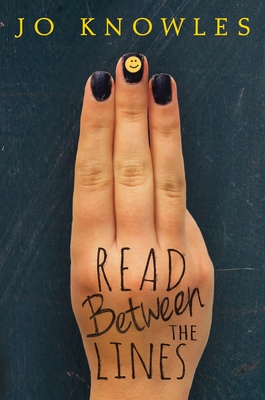
Read Between the Lines by Jo Knowles tells all these
stories and more. The book contains ten short stories total, with each
character's tale roughly 40 pages long. The storylines overlap and
connect, woven together by setting - all of the stories take place in
the same town, on the same day - as strangers, neighbors, relatives,
co-workers and classmates interact, ignore, confront, and combust.
Set
aside some time for this book, because once you've finished reading it,
you may feel compelled to read it again! If you read this book a second
time, you will pick up on even more of the connections, causes, and
consequences, just like when you read a mystery for the second time, you
pick up on more of the clues because you already know the identity (and
intentions) of the murderer.
The author said that this book was
inspired by a stranger who flipped off her family while driving down
the road. That symbol of disrespect is in each of the stories, which may
make some parents or teachers hesitate, but don't be worried - overall,
the book is fairly PG.
Read Between the Lines is both frank and
considerate, honest in its depiction of emotional abuse, intolerance,
secrets, and hierarchies within families, classrooms, and communities.
Though they have different backgrounds and different interests, each
character is trying to find a place for herself or himself in the world,
and there's something universal in that search for identity and
belonging. The point of the book is to pause, to think, to consider, to
look, to look again: we don't always know what's happened to others to
make them act or react the way they do; we can't read their minds, we
don't know what their day has been like or what their home situation is,
but if we take a moment to consider other people's feelings, to respect
their space and hear their side of the story, we might be find we are
more alike and more connected that we think.


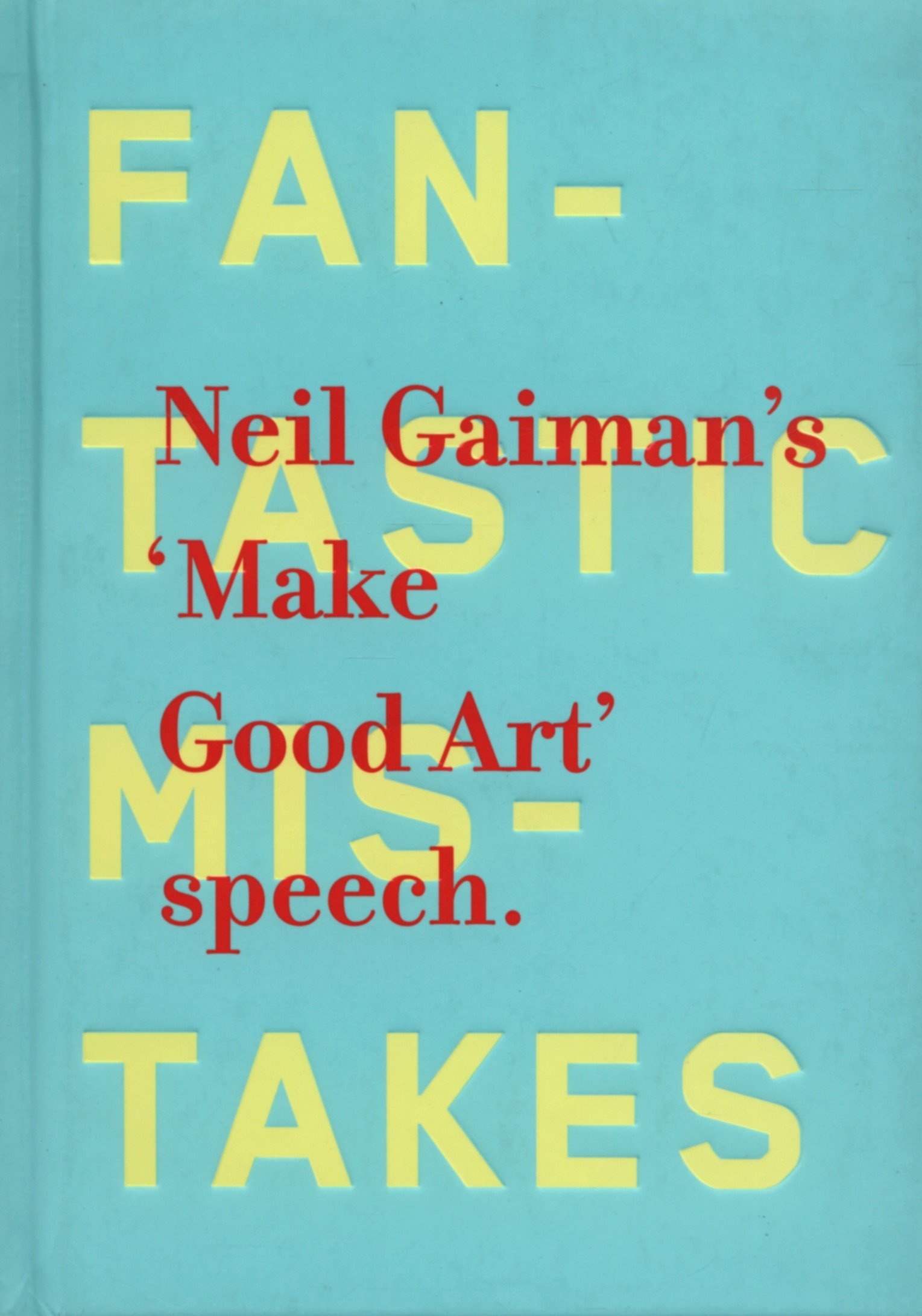 And yes, that appears to be the actual title of this small book, though one usually finds it as Make Good Art by Neil Gaiman, with graphic design by Chip Kidd. The text is something that Gaiman wrote for a commencement speech, which he delivered in 2012 to the University of the Arts. The book is a triumph of graphic design, using a variety of fonts, font sizes, and several colors (turquoise, red and white), to convey the text, which is both inspirational and aspirational. It's the perfect gift for new graduates, or for anyone anywhere involved in a creative life (which is, to be fair, most everyone I know).

 Review ARC courtesy of Macmillan/Feiwel and Friends Publishing