In Elizabeth Laban's The Tragedy Paper,
readers will discover a coming-of-age story set in a traditional
location (boarding school) with a familiar setup (love triangle) that
turns everything you think you know about this sort of book on its ear.
Laban might be giving readers a familiar setting and situations but
her characters are so thoughtful and the plot just twisty enough that
she manages a page-turner out of the quietest of stories. The conceit
is straightforward: Tim met Vanessa while stuck at the airport on his
way to his new school. After sharing the sort of fun (and mostly
chaste) boy-meets-girl story everyone dreams of, they continue on their
separate ways, and he discovers she is not only a fellow student but
dating the school's most popular boy. They become good friends as Tim
also slowly becomes enmeshed in the school's senior class tradition. It
is on one fateful night involving the seniors that he connects with
Duncan, the underclassman whose story is really at the heart of the
novel.
Laban introduces Duncan in the very beginning as the one who figures
it all out. He knows how Tim's school story ended the previous year,
but not how it began, and along with the reader, he learns all the
sordid history via a series of CDs that Tim has left behind for him in
his dorm room as part of a departing senior gift, another school
tradition. Duncan has a small but powerful connection to Tim that has
left him unsure about his own future, and so hearing Tim's voice,
finding out why everything happened the previous year, is critical to
his own wellbeing. In the middle of all of this looms the big senior
assignment: the "tragedy" paper. Talk of tragedy permeates the senior
English class, literary examples are tossed about throughout the text,
and Duncan, in particular, is overwhelmed with a desire to get the
paper right. Laban makes clear though that tragedy is in the eye of the
beholder, and also that while it might reach epic literary proportions
for some students, for others the tragic is all too real and in danger
of eclipsing every other facet of their lives.
It's important to note that nothing huge takes place in The Tragedy Paper.
There is a serious accident, and in both Tim and Duncan's narratives,
there are students in trouble, but in comparison to a lot of
contemporary YA fiction, the events here are subtle and familiar. Much
of the book is about aspiring and struggling to find your way to the
best sort of self, and the obstacles, both internal and external, that
block your way. This novel is the very definition of powerful, and
while it does not possess characters spouting the sort of fake
witticisms that seem to crop up all over in teen books lately, they are
nothing if not real. There are no villains in The Tragedy Paper, just a lot of wishing you can get things right; a lot of trying to do the best you can.
Cross posted from my Bookslut YA Column.

Wednesday, March 13, 2013

Monday, March 11, 2013
In Darkness by Nick Lake

"When you keep hurting someone, you do one of three things. Either you fill them up with hate, and they destroy everything around them. Or you fill them up with sadness, and they destroy themselves. Or you fill them up with justice, and they try to destroy everything that's bad and cruel in this world" (87).
Nick Lake’s In Darkness begins, well, in darkness. The literal darkness one finds when trapped beneath the rubble of the massive earthquake that devastated Haiti in 2010. The figurative darkness of the young “chimére” (gangster) Shorty, who has grown up in Site Soléy, one of the poorest and most dangerous places in the world, a place where the sociopathic gang lord is also the person who has done the most good. And the moral darkness of a benighted government, whose constant corruption enslaves most of its citizens to a bleak future.
It was not supposed to be this way for Haiti, not after Toussaint L’Ouverture led the slave rebellion in the late 18th century, overthrowing the French colonizers. Haiti was to be a light for all the enslaved people in the world, a beacon for freedom. Using the ceremonies and belief system of “vodou,” Lake directly connects the lives of a contemporary teenage Haitian gangster and the (slightly re-imagined) historical figure of L’Ouverture: one a character filled with hate and bent on destruction, and the other yearning for justice, and bent on seeing it happen for his people and his nation.
In Darkness is by no means an easy experience. Shorty’s world is violent (as is L’Ouverture’s), and the grim reality of life in Site Soléy retains the ability to shock even the most jaded reader. To his credit, Lake presents Site Soléy in all of its moral and spiritual complexities. And though L’Ouverture’s life ends in the darkness of a French prison cell, Shorty’s story ultimately gives us a ray of light. In Darkness was the recipient of the 2013 Michael L. Printz Award for Excellence in Young Adult Literature.
Wednesday, March 6, 2013
Store of the Worlds: The Stories of Robert Sheckley, edited by Alex Abramovich and Jonathan Lethem
 Chances are good that you’re not familiar with Robert
Sheckley. Don’t feel bad—I wasn’t
familiar with him either until less than a year ago, when New York Review Books
(that great bastion of unjustly forgotten writers and works) released Store of the Worlds, an collection of
his short stories. Sheckley was a
mainstay of science fiction anthology magazines in their heyday—Amazing, The Magazine of Fantasy and Science Fiction, Omni, Weird Tales, et
cetera—although he also published in “higher-class” magazine as well (Esquire, Playboy, Semiotext(e), even Cosmopolitan). And yet today—less than ten years after his
death—he is practically forgotten, with almost all of his work out of
print. And that’s terrible.
Chances are good that you’re not familiar with Robert
Sheckley. Don’t feel bad—I wasn’t
familiar with him either until less than a year ago, when New York Review Books
(that great bastion of unjustly forgotten writers and works) released Store of the Worlds, an collection of
his short stories. Sheckley was a
mainstay of science fiction anthology magazines in their heyday—Amazing, The Magazine of Fantasy and Science Fiction, Omni, Weird Tales, et
cetera—although he also published in “higher-class” magazine as well (Esquire, Playboy, Semiotext(e), even Cosmopolitan). And yet today—less than ten years after his
death—he is practically forgotten, with almost all of his work out of
print. And that’s terrible.Tuesday, March 5, 2013
Black Swan Green by David Mitchell
 Jason Taylor has all the problems of a typical 13 year-old. He worries over his status amongst his peers; he worries over what girls think of him, or if they do at all. He has to put up with his older sister and feels disconnected from his parents. On top of all that he has a speech impediment. He's a chronic stutterer, a condition which came on rather suddenly during a class game of Hangman. He has special problems with words beginning with N and S, so he communicates through a series of workarounds, often rephrasing simple sentences to get his point across.
The summary above makes David Mitchell's Black Swan Green seem like a rather standard young adult novel. It is anything but. What sets it apart is, for one, the voice of Jason Taylor which is both breathless and witty. He divides himself into multiple personalities (not in a lunatic sort of way) including the Hangman who is responsible for his stutter and the Unborn Twin who sometimes acts as his conscious.
Friday, March 1, 2013
Snowmobile by Jules Older - some fascinating mechanical history
 One the most ubiquitous things about life in Alaska is the number of snowmachines*. Everybody has one or access to one and during the winter (until it gets too cold), you are just as likely to see people run an errand on a snowmachine as in a car. As far as recreation, they truly are everywhere and if you have ever been on one you would understand why. They go incredibly fast, as are pretty easy to control and just a blast run around on. As popular as they are in many northern climates however, few people likely know about Joseph-Armand Bombardier and his decades-long goal to invent a vehicle that could move on snow. That's where this very basic, short history Snowmobile: Bombardier's Dream Machine by Jules Older comes in handy.
Wednesday, February 27, 2013
The Treasure of Alpheus Winterborn
 The Treasure of Alpheus Winterborn by John Bellairs
Eccentric millionaire (is there any better kind?) Alpheus T. Winterborn built a castle-like building which houses the Hoosac Public Library. It also houses a great treasure, or so the stories go. One day, young page Anthony Monday finds a gold coin hidden in the molding and begins to think there's truth to this crazy story. Unfortunately, so does Hugo Philpotts, Winterborn's greedy nephew. With the help of Miss Eells, the town librarian, Anthony races to find the treasure and save his family from financial ruin before Mr. Philpotts can get his sinister claws into the treasure.
I was inspired to pick up this book in part because I have a gaping hole in my knowledge of juvenile and middle grade
fiction, a hole that's only gotten deeper since I moved up into the adult services division at work. I was also in the mood for a good solid mystery, and who can resist a mystery in which a plucky youngster and a librarian team up? And I think I was also inspired by previous posts here in Guys Lit Wire on the Pursuit of Lost Books.
Monday, February 25, 2013
Bomb: The Race to Build–and Steal–the World's Most Dangerous Weapon by Steve Sheinkin
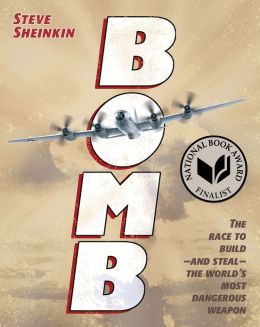
Writing to Lise Meitner, his former collaborator, Hahn explained what he'd found. Meitner and her nephew, Otto Frisch, were physicists, and though both were amazed by Hahn's news, Meitner was also aware that "We have experienced so many surprises in nuclear physics that one cannot say without hesitation about anything: 'It's impossible.'" (p. 14) Sketching a diagram and doing some math, Meitner and Frisch realized it was, in fact, possible to split an atom. Not only that, but the energy released by splitting an atom is immense. And if you had enough uranium and figured out how to split all those uranium atoms at the same time, you would have the most powerful bomb ever.
The only question was, who would get the bomb first?
Remember, this happened in late 1938. Germany, with its long tradition of scientific achievement—particularly in physics—was led by Adolf Hitler and had already occupied and annexed Austria. Czechoslovakia is in its sights, and World War II will begin not much later, in 1939.
Thursday, February 21, 2013

Wednesday, February 20, 2013
Slam! by Walter Dean Myers
 I was supposed to post this last week, but was distracted and forgot. Slam! is a good basketball story. Very good, in fact. So here's an excerpt:
Coach went around... telling everybody not to feel bad. He was feeling bad, though, and you could see that all over his face...
Me and Ducky started to the bus stop and a car pulled up. It was Ducky's mom.
"Can we drop you someplace?" she asked.
"Bet."
Yo, Ducky's mom was fine. If she wasn't white and about thirty-something I might have given her a play. She got the hint real quick that we had blown the game and went on about how crowded it was downtown. Ducky didn't want to hear that mess and neither did I so she shut up.
"I'll come to the next game if I can," she said when she left me off on 145th.
"You lucky?" I asked.
"I think so," she said, and flashed me a pretty smile.
I got upstairs and a little big-eyed boy named Donnie was standing on the landing.
"Your father got shot," he said.
I busted down the hall and saw the door was unlocked. My heart was jumping when I ran in. Moms was making coffee at the stove and Derek was reading a comic.
"Where's Pops?" I asked.
"He's in the living room watching television," Moms said. "You hear he broke his arm?"
"Broke his arm?" I looked down the hallway toward the living room but I couldn't see nothing. "Donnie said he got shot."
"He's only four," Moms said. "Anytime somebody gets hurt around here the little kids think they got shot. No, he just broke his arm."
Tuesday, February 19, 2013
So Depressing it Could be a Post-Apocalyptic Nightmare but it Isn't
 I'm working on a new genre category in which to place Andrew Smith's In the Path of Falling Objects. Apocalyptorical Fiction? Dystopical Fiction?
This novel, an earlier offering by the author of The Marbury Lens, features a bleak, empty landscape populated with the desperate and violent fringes of humanity. It has a lot in common with post-apocalyptic fables like Cormac McCarthy's The Road. But this novel is not set in some near future that has suffered an environmental or nuclear holocaust, showing us a world devastated by human stupidity. Instead it is set in the very familiar American Southwest and not in the future at all, but in the recent past, in the 1960s.
Subscribe to:
Posts
(
Atom
)