Monday, October 27, 2008

Sunday, October 26, 2008

Teen Screen 101


It's been a while since I've run across a book that leaves me running hot and cold depending on my mood when I pick it up. On the one hand what we have is a thorough course in film media awareness, a textbook for exploration of writing for television and film; On the other hand the aim seems to be driven toward raising an army of teen screenwriters armed with the skills to keep turning out the same sort of studio drivel that has been cranked out for decades now. In the end I find myself forced to admit that had this book been around when I was a teen I would have owned it and probably would have been a different writer as a result, for better or worse I couldn't say.

Screenwriting for Teens presents each of the principles on the right side page with a clear explanation and examples. Flip the page and there is a "look and learn" segment recommending films, TV shows, and even commercials that support the principle at hand. There's also a "brainstorming" section that provides three different exercises to reinforce the lesson and provide young readers with a broader background in understand how to write.

The book opens with a lesson on the differentiation between books and movies, with a brief study of classic story structure, and quickly builds up to short studies on cinematic structure and the Hollywood method for developing a marketable screenplay. In these bite-sized segments a young writer will learn much of what is taught in most other books and seminars on screenwriting and it is highly accessible. The examples are, for the most part, well-chosen and the exercises are solid enough even for experienced writers to get something from them.

Where the book falters for me is how it seems to go out of its way to not look like a textbook or something equally formidable, but in doing so treats the serious student too casually. "If you're not already keeping a daily journal, start one" seems like something that should come at the beginning of the book and not as an aside eight chapters in. Additionally, there is an unspoken assumption that the reader has an endless amount of time and access to watching television shows and movies without really letting the budding writer know what they're getting into. Granted, the serious student will devour these assignments and hunt down whatever looks interesting to them, but just as many might find the task daunting part way through and be tempted to give up.

With the ever-changing television line-ups and cultural phenomena there are references to television shows no longer on the air, as well as films that even most film students in college have never seen. And very quickly it becomes clear that this is a book that one cannot breeze through in a month or even a few months. Watching the recommended films and programs, following through on the activities will take time. What Hamlett hasn't also adequately prepared the budding screenwriter with is a lesson in patience.

Yet, I still like what this book does. It says to the teenage screenwriter "Okay, this is what it's all about" and plows ahead with its challenge to keep up. Those who think that writing for television or movies is a shortcut to fame will quickly learn that the modern screenwriter's craft is no less arduous than any other writer's. Serious teens who believe this is truly their destiny should make this a first test of their strength and endurance. This would only be a first stop because there is much more about character and scene development that a solid screenwriter needs to know and should learn from other books on the craft. Syd Field's books, and Robert McKee's Story and, just to get some perspective from a master in the field, William Goldman's
Adventures in the Screen Trade, to name a few of the better ones.

For the first-timer, the student looking to make solid short films and develop themselves as screenwriters, Hamlett's book is a step in the right direction.

Screenwriting for Teens
The 100 Principles of Screenwriting Every Budding Writer Must Know
by Christina Hamlett
Michael Wiese Productions 2006

also mentioned:
Story: Substance, Structure, Style, and the Principles of Screenwriting
William McKee

Adventures in the Screen Trade
by William Goldman

Screenplay: The Foundations of Screenwriting
and
The Screenwriter's Workbook

both by Syd Field

Saturday, October 25, 2008

David Almond blogging Day 2

Or: "What's there to be afraid of? It's only in your head..."

Last week*, I ended by admitting that there is something frightening about David Almond's books, something powerful and dark and mysterious. It's this very quality, his ability to turn a world we accept without thinking into a stark and terrible truth simply by exposing it to the power of imagination, that I find so compelling in his work.

Okay, so what does that mean? Well, I think Almond's books fall into two types (if I can be so crass as to bluntly categorize one man's entire body of work), and Skellig, his first book and the one I discussed last time, falls into the first category, in which Almond explores what is frightening about the world around us, and how we triumph over that fear with imagination.

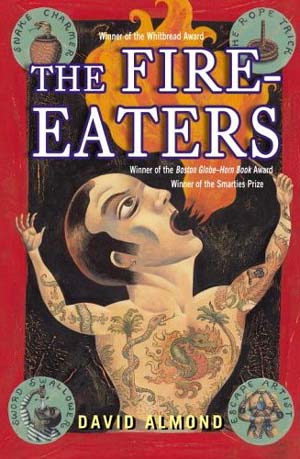
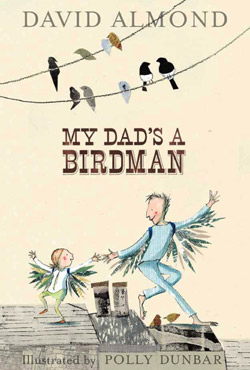
Maybe I'm wrong about this, but if you look at books like The Fire Eaters (one of my personal favorites), My Dad's a Birdman, Skellig, and his latest, The Savage, you find a core conflict at work: individual kids struggling with threats--ominous, nebulous--threats and fears encroaching from the outside world. And their struggle is as much one of imagination as it is something concrete.
As imperfect a choice as it may be, I use that word "concrete" to avoid the word "real", because in a David Almond novel, questions about what is real and what is not are almost not worth asking--the mind is powerful enough to conjure both angels and demons, and sometimes, as with Skellig, it is unclear which is which.

All this is nebulous, so let me give an example. His chapter book, My Dad's a Birdman, is often overlooked because it is aimed at younger readers, however, in many ways, it's the best place to stare. What I'm talking about is quite clear at the outset. The main character, Lizzie, is motherless, and her father is nearly useless, pretending he's a birdman, requiring Lizzie to cajole him into eating, showering, shaving, etc. The book opens with a scene much like most schoolday mornings: a parent pushing, arguing, prodding their kid to get ready for school. Only here it is not the parent doing the prodding, but the child, and it is not a kid that resists getting ready and getting on with their day, but the father.

I'm in the middle of reading this book to my 5 year old daughter, and I could tell from the beginning that she was riveted by it, caught somewhere between excitement and unease. Within its pages, the natural order of the world is upended: everythings is reversed--a child is responsible for an adult, and a parent acts out, playing pretend and ignoring the rules of what should be. My daughter finds it strange, funny, and disturbing all at the same time. She's hooked.
Imagination, then, both transforms and violates, through its ability to take off in flight (I think it's no coincidence that wings play a large role in many of David Almond's novels) and to threaten everything and everyone around. In The Fire Eaters, the book opens with Bobby Burns witnessing a homeless carny named McNulty swallow fire and pierce his flesh with knives. It's a great opening, and very David Almond: vivid and grotesque. But, while Bobby is disturbed by McNulty, there's something about the fire-eater that gets under his skin, that he absorbs and makes his own--which then opens the door for Bobby to confront some of the more personal demons (an oppressive new school, a growing distance from his best friend) that come up in the novel through his own defiant, sensational, and disturbing actions.

But there's another kind of David Almond novel, one in which the disturbing swirl of the darkest substance a young mind can conjure creates a world all its own, outside the influence of the orderly world of adults. And that, for me, is the best Almond has to offer--and I explore that more in my next David Almond blog (hopefully much less than a week away...)

*btw: sorry it's taken me so long to get this follow-up post on here--I've been waylaid by illness, but am feeling much better now.
(edited to add links)

Friday, October 24, 2008

So you want to rule the (Under) World?


Please allow me to introduce myself
I'm a man of wealth and taste
I've been around for a long, long year
Stole many a man's soul and faith
-Rolling Stones’ “Sympathy for the Devil”


The devil’s been making appearances in books for a long, long time -- I.e., the Bible -- but I’m not sure anybody’s every nailed the character like Neil Gaiman does in the Sandman graphic novels.

One of the challenges of a comic book is making you scared for the main character. When’s the last time you were really scared for Wolverine? But when The Sandman, who is a powerful man after all, goes to Hell in “Season of Mists” it really is scary, because Gaiman’s Lucifer is so very bad.

But the book I really want to talk about here presents the other side of Lucifer altogether. What if he was good? What if he wanted to make the world a better place? Really. No tricks. He wants to help. Would you help Satan?


Our hero, Captain Von Bek, is a warrior, a real Medeival bad ass. They call him “Kreighund” or “The War Hound.” He’s no devil worshipper, but he becomes entangled with the Evil One. Whereupon Satan escorts Von Bek to Hell and explains his problem.

The Lord of Hell has been Lord of Hell for a long, long time, ever since he was thrown out of heaven. He had been an angel and now he’s a rather bored keeper of the flames of torment.

Satan: “I am weary of the Earth and still more weary of hell, captain. I yearn for my position in Heaven.”
Von Bek: “But if Your Majesty is truly repentant…”
Satan: “It must be proved. I must make amends.”


But how do you make amends to God, when he threw you out and has been ignoring you for millenia? You need to make a big gesture, right? And Satan has decided that his gesture will be finding the Cure for the World’s Pain. And, for reasons too complicated to go into now, he needs Captain Von Bek’s help to do it.

This book is “The War Hound and The World’s Pain,” by Michael Moorcock. It’s intellectually challenging sword and sorcery and the ending is stranger still and may require you to rethink your world view.

As for the author, Michael Moorcock, I can hardly recommend him highly enough. He has many tales of many different flavors, some of which interweave to create the story of the Eternal Champion. The Elric books are a great place to start if you want some really heaby duty sword and sorcery. But if you want to really blow your mind, try An Alien Heat, the first of an amazing series of books about the people who are alive at the End of Time.


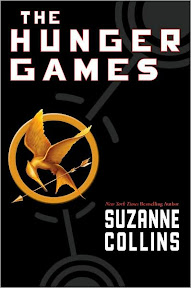
The Hunger Games by Suzanne Collins

Hunger Games book coverReviewed by Steven Wolk.

I have never watched a "reality show." Supernanny, Survivor, Big Brother, Wife Swap, and on and on and on, I’ve never seen one of them. Sure, I’ve caught ten seconds here and there as I flipped channels, but I’ve never parked myself on a couch and flipped one on. The fact is, I don’t watch much TV, but reality shows take my disdain significantly further. I just don’t like the idea of the shows. And besides, there isn't much "reality" in reality TV, but a manufactured reality. They are, after all, a TV show. Enter The Hunger Games, a dystopian novel (with a dash of sci-fi fantasy) about reality TV – and society – gone amok. I may not like the shows, but I had to read this book. And once you start reading it you will zip through it like the story’s tracker jacker bees, honing in hungrily on a victim. This is a dazzling book that should be devoured by middle and high school kids and adults.

It is the future. The United States is no longer and in its place is Panem, which is divided into twelve districts. Each district focuses on a commodity. While one district does the agriculture another does the coal mining. There is a clear hierarchy to the districts; a class system. Food is scarce; some people choose (illegally) to hunt for food. Rulers in the Capitol, a wealthy and somewhat mysterious epicenter of power, run Panem. Clearly they have a very good life while the people struggle. Each year the rulers host a reality show – The Hunger Games -- that pit people from each district against each other. One boy and one girl – 24 in all -- are selected in a lottery to compete. But there’s a catch. There’s only one winner because in the end, there is only one still alive. That’s right, Jerry Springer is a walk in the park compared to the Hunger Games, where kids from twelve to seventeen fight to the death in a chosen arena – and it’s all a wildly popular TV show. The Hunger Games is, almost needlessly to say, the first book in a trilogy.

Sixteen year-old Katniss lives in District 12, the land of near-destitute coal mining, and immediately volunteers to replace her younger sister in the Hunger Games after she’s selected in the lottery. Katniss has at least one advantage: The arena for this year’s games takes place in a forest, and Kat has become something of an expert hunter to keep her family fed. That’s right, Katniss is a hunter, but now she will have to hunt people – no. make that children – to stay alive. So, right about now you might be thinking how disturbing this sounds. Well, it’s meant to be disturbing.

Out there, roaming the forest, in fear of imminent attack, Katniss is a jumble of emotions and intellect. She is not only a hunter, but she is smart. And she is weighed down by the complex emotions over two boys, Gale, her hunting partner back home, and Peeta, the other District 12 participant in the games she became close to during their pre-games training. Kat knows – and we know – that for her to win Peeta must die. And constantly hovering over her like an ominous cloud that never leaves are the Gamemakers in the Capital, because they are controlling much of what happens in the arena during the games, just like they are using their power -- and entertainment – to control the people of Panem.

Like all great dystopian novels, The Hunger Games may take place in the future, but the story is really about life today. Sure, we’re not watching people slaughter each other on TV, but our nation loves to watch men pound each other in the boxing ring and pay-per-view "Ultimate Fighting" and tune into Maury to witness people scream at each other about a pregnant fifteen year-old, not to mention the endless TV shows and movies focused on pretend violence and our very real wars with their very real violence. So, yes, the book is disturbing and tense and sometimes graphic. But maybe our lives are not all that far from the Hunger Games?

Peeps by Scott Westerfeld

Last week, Shelf Elf pointed out how many vampire books are written for girls. It's true, but my problem with vampire books has been how interchangeable many of them seem. Take a vampire from one book and you could probably plop him or her into another vampire book without making any changes. More than just the pointy teeth or thirst for blood, it's the moody atmosphere, the angst-ridden vampires, and the way they were turned into vampires to begin with. There are exceptions, of course, and of the exceptions, Peeps stands far ahead of the rest, with vampires unlike any I've ever read before.

Meet Cal, who went to New York for a college education but ended up with a lot more. After hooking up with a girl he met at a seedy bar, he became infected with a parasite that he will end up passing on to anyone else he hooks up with.

In a way, Cal is lucky: he’s only a carrier, one of the rare ones, with the enhanced senses and abilities of a parasite positive, or peep, but without any of its other effects, like an aversion to light and craving for blood. Because in Cal’s world, vampirism is an STD caused by a parasite. And he refuses to infect anyone else, which is hard enough when you’re nineteen years old and single, nevermind when you meet a girl you actually want to be with.

Now Cal’s working for the Night Watch, a secret group which has fought vampirism for centuries. He’s tracking down all the girls he inadvertently infected and trying to find the girl who infected him in the first place.

So, like vampire books? Read Peeps. Don’t like vampire books? Read Peeps anyway. It’s a fast-paced, exciting take on vampires by Scott Westerfeld (author of the Uglies series) that will have you on the edge of your seat when you're not squirming with disgust.

Oh, did I not mention all the details about parasites? If you're fascinated by parasites, you're in luck! In each odd-numbered chapter, Cal narrates his story, while relating graphic and often rather gross information about real-life parasites in the even-numbered chapters. The parasite chapters are interesting and don't slow down the story's momentum at all. Combined, these elements plus Westerfeld's storytelling add up to form one creepy story, a vampire book that may actually scare you.

Thursday, October 23, 2008

Prince of Stories


Tor reports on a new book for Neil Gaiman fans that sounds quite impressive:

At any rate, I have excellent news for the ever-growing legions of Gaiman fans out there: your favorite obsession is about to get a bit easier to manage. At the end of this month, St. Martin’s Press will be releasing Prince of Stories: The Many Worlds of Neil Gaiman, which features a guide to the complete works along with insights and interviews with some of the very, very cool people who know him best. Gaiman is famous for being a man who wears many hats—novelist, writer of comic books, children’s author, screenwriter, poet, filmmaker, and so on—Prince of Stories peeks under each one in turn, bringing into focus the intricate connections, shared points of inspiration, and thematic parallels casually interwoven into the elaborate tapestry of a master storyteller.

Tuesday, October 21, 2008

Higher Learning: What I've Learned by Talking to College Guys about Books

I've interviewed four college students in the past few months about books and reading. I asked them what they read now, what they read as children and in high school, and what they think about Young Adult Fiction. I'll be continuing this series again in November, but this month I wanted to step back for a moment and think about what I've learned from speaking with these young men. Here goes:

1. If we base anything on four interviews, the first thing I've learned is that there is no "guy reader" demographic. When asked "what are you reading now?" two students responded with novels, and two with non fiction. Granted the readers of fiction are both English majors, but still..we can't really say "guys like non fiction."

2. Young Adult fiction is not something that touched the lives of these four students when they were in high school. One student equates Young Adult with romance novels, and the other three see it as a section in the library or book store. With the Golden Age of Young Adult fiction upon us, I expect this will change, but I still found their answers interesting.

3. While College Guys read broadly and have different reading preferences, they do share similar tastes in comfort reads. They like to go back to what they read as teens when in need of a break. Fantasy is popular (Garth Nix, Ursula LeGuin, Terry Goodkind), as is Historical Fiction (Patrick O'Brian) and Stephen King.

4. Three of the four students mentioned Philip Pullman's His Dark Materials as an important series for them in Middle School.

So, there you have it. I've learned there is no such thing as a typical "guy reader," something that surprised me. How one markets books to teen boys, I'll never understand.


Monday, October 20, 2008

Support teen writers

Kris Reisz is doing something good with his writing talent. Here's how you can help:

Yesterday, I wrote about my friend Robert and the writing program he's developed for the adolescents at the hospital

The program has been such a success, Robert wants to try something similar out in the community. He's enlisted me and together, we've put together The 360 West Project.

Right now, the plan is a two-month course, meeting weekly, leading up to a reading where the students can invite their family. We want to focus less on getting published and achieving great literary success, and more on developing the students' own voices and getting them to see the world through fresh eyes. (Not that I could tell them anything about achieving great literary success if I wanted to.)

I've never taught anything before, so this is going to be an interesting experience. The class starts the 28th, which feels terrifyingly close.

Right now, we've got a great location at Robert's church (one of the advantages of working with a preacher) but we need a new printer and some other incidentals. Also, we want to bind our own books for the reading with all the students work in them.

To raise some money, Robert is selling copies of Stranded in Skin and Bones: A Memoir of Faith and Madness. Like I said in my last post, Robert's had a pretty interesting ride. Stranded weaves together his life and the lives of his patients at the psych hospital. I know quite a few of you have enjoyed my stories about working there, and I know you'd like this book too. Plus, each copy is very nicely hand-bound and autographed.

They cost $6 each, with all the money going to the Project. There's a short excerpt below. If you'd like a copy, email me at KrisReisz@gmail.com. Other than that, just wish me luck come the 28th.

Stranded in Skin and Bones by Robert Stofel

I work as a psych tech, which means I get all of the dirty work. If the psych patients puke, I clean it up. If they wander into the wrong room, I retrieve them. I take them to the nameplate outside their door and say, “This is your room. See. This is your name.” I take them out to smoke. I show them the location of the lighter on the wall of the smoking porch. I demonstrate how to use it. No lighters allowed. They may burn the place down. I’m their guide through Lala Land. I’m their shepherd in fields of madness, even though I was once a lot like them—paranoid and eccentric.


Read more here
.

826 National - A Place to Write

I started writing stories and poetry early in high school. I didn’t receive any constructive criticism of my creative writing until I was in college. Most adult writers divulge that their initial attempts at writing were solitary ventures—notes kept in boxes in a dark closet or under the bed gathering dust. I am a writer today because I received encouragement in college, but I do wonder what might have been if I had someone look at my writing earlier. Even if someone had read one of my poems and said, “Hey, dude, it needs work, but keep at it.” I would have kept at it. I would have learned years before I eventually did, that a life spent writing, that a pursuit of a life with words, is a thing that can be shared and brought to light.

There is a place, in seven great cities, where a young writer can find a writing guide. 826 National is an organization “dedicated to supporting students ages 6 to 18 with their writing skills, and to helping teachers get their students excited about the writing.”

Founded by author Dave Eggers and educator Nínive Calegari, 826 National offers drop-in-tutoring, writing workshops (in great stuff like creating zines, college essays, journalism, fiction, non-fiction, English as a second language, and more), and class field trips. Their mission “is based on the understanding that great leaps in learning can happen with one-on-one attention, and that strong writing skills are fundamental to future success.” If you live in San Francisco, NYC, Los Angeles, Ann Arbor, Seattle, Chicago, and Boston, and you have a passion for writing and a desire to learn how to pursue the craft, then you should get connected with 826 National.

If you think this is a great idea, then you’re not alone. Eggers recently won a the distinguished TED Prize, and the 826 National programs have received attention from the national press.

Those of us who don’t live in one of the cities listed above will have to wait until the program grows. In the meantime, you can read books by Dave Eggers. My favorite Eggers books are A Heartbreaking Work of Staggering Genius (a memoir of the Eggers family’s tragic circumstances) and What Is the What: The Autobiography of Valentino Achak Deng (a fictionalized memoir of the Lost Boys of Sudan). The power of Eggers’s writing is to cut to the heart of the matter with humorous and clever prose. He doesn’t spoon sweetness into difficult moments, and he doesn’t hide the wounds and embarrassments of his subjects.

Eggers could have settled into the comfortable life of a successful author. He could have eased into writing richly successful witty stories and retired with his winnings. Instead, he chose to continue to write on the edge, to publish daring and terrific writing (yes, he publishes as well), and to give back to communities though the 826 National programs. A life in full is a life we should admire and support (by donating to support the 826 National mission).