Friday, October 17, 2008

Vampires Aren't Just for Girls Y'Know


These days, it would seem that if you're not writing a book about a vampire, you're not a writer. They're everywhere. Heartthrob vampires. Socialite vampires. Gritty urban vampires. It's enough to make a reader want to start wearing a garlic garland into the bookstore. Most of said vampire stories are written for a particular teen girl readership. So fellas, if you were feeling left out, I have something to recommend in the pointy-teeth category. Canadian author Max Turner's debut novel, Night Runner proves that vampire stories aren't just for the ladies anymore.

Zack Thomson has been living in a mental institution for years, since his father's death and since the emergence of his strange and severe allergies. He spends most of his time alone, since his skin cannot take even the smallest amount of daylight. He keeps unusual hours, staying awake most of the night, running on a treadmill and playing video games. His life is pretty scheduled, very orderly, and extremely sheltered, until one day a stranger with shocking abilities crashes his motorcycle into the Nicholls Ward with an ominous warning, "Don't let the cops get you. He's coming. Run!" From that moment, everything Zack thought he knew about himself shatters. He learns he is (get ready for it)... a vampire, and that his archaeologist father was a vampire hunter. Sheltered for some time in the mental ward, Zack had been protected from people who wished to abuse his powers or even harm him. Now he is on the run, hunted by some pretty nasty characters. He will come to rely on friends, and people he hardly knows, to navigate his new reality.


This is a quick read. Most of the chapters are super-short, and nearly every one ends on a cliffhanger, making you want to just keep reading. I think that this is a good thing overall, given the nature of the story, but sometimes I find too many short chapters in a book is a bit gimmicky, almost insinuating that the reader needs that constant start and stop to keep the suspense going. I would not have objected to longer chapters, with a slow and steady increase in tension throughout, as opposed to the feeling of constantly starting and stopping as the chapters raced by. In a way, this almost created a choppy sensation during reading. I didn't feel I got the chance to settle into many of the chapters as they were over mere pages after they started.

I enjoyed reading a vampire story where romance was not the central focus. This is more of a tale of survival and self-acceptance than it is a love story, although there is a romantic thread running through the narrative. It's mostly about Zack learning to handle being a vampire, and coming to terms with the power and danger inherent in his new identity.

Turner has clean and direct style that should sit well with all sorts of readers. He can do humor, and he knows how to write an action sequence in a way that brings clear images to mind. In fact, I could really imagine this story on the screen. There's some well-placed gore, and a whole lot of creepy fog. If you're into Darren Shan, and if you're sick of everyone blathering on about some girly vampire book called Twilight, then I suggest you give this one a try. I wouldn't be surprised to see Night Runner become a series, given the ending. And why not? Guys deserve vampire books too.

Thursday, October 16, 2008

David Almond titles: The Savage & Skellig


David Almond writes books unlike anyone else, and for that reason alone you should gobble up everything you can by him.

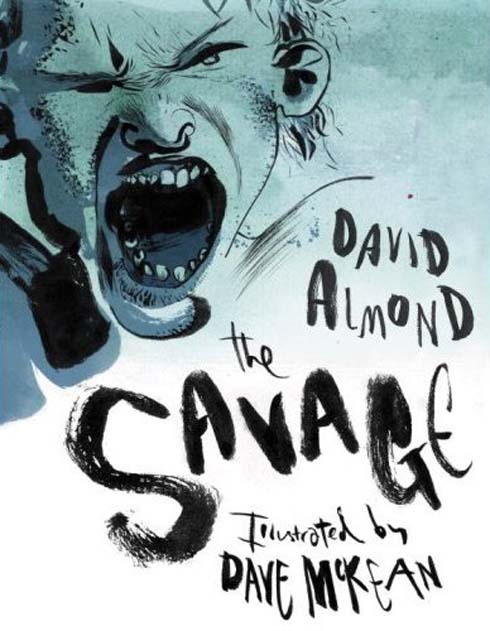
You can start with his latest book, The Savage, which has everything that's great about Almond, plus illustrations (comics-within-the-novel?) by the phenomenal Dave McKean.

I'm telling you, don't waste your time on my prose, go get some Almond now! But, if you want more reasons why, join me after the jump.

I first discovered David Almond on a road trip to see him up in Cincinnati, Ohio back ten years or so ago when he was nominated for the Michael L. Printz award for his first book, Skellig (and that first year was an amazing one for the Printz award, and YA in general: Skellig, Speak by Laurie Halse Anderson, and Ellen Wittlinger's Hard Love all lost to Walter Dean Myers Monster. Not until the one-two punch of 2006 and 2007 has there been as good a lineup). Librarians and kidslit booksellers from the region (I was working in a bookstore in Louisville, Kentucky at the time) had been invited by the publisher to come to a swanky dinner with him at the Ruth's Chris Steakhouse as a celebration--and, of course, to promote Mr. Almond, a first-time British author, and the award, that being its first year.

Skellig is great, and, while I can lay out the plot for you, it simply doesn't do justice to the murky, head-swirling wonder of Almond's language and mood. Skellig is the story of Michael, a kid whose family has just moved into a dilapidated old house. Michael, friendless, angry, and scared for his baby sister's health, takes to exploring around the house, including the broken down garage, where he finds Skellig, a creepy, dessicated man with wings. Is Skellig an angel? Is he even real? And what is the connection between this man or creature and Michael's sister?

Okay, what I wrote sounds more like cover copy than a description of a book, but that's because this book, like all of David Almond's work, raises questions, causes you to ponder the connections between what is real and what is imagination, and is that even worth distinguishing between? So, just--David Almond = awesomeness.

Anyways, I finished Skellig hours before the road trip: me and two elderly booksellers who knew their kidslit, and were usually spot on when finding good books (they were the first ones to tell me about Harry Potter, and that was pre-HP1 publication over here). I loved the book, it excited me like no other book published that year (except maybe Speak, but that would come a month or so later). But the car ride turned uncomfortable when I tried to talk to the Marthas about it (they were both named Martha).

They said it was beautifully written, but it was "so dark!" They had this stern look of concern that surprised me--a look that said they were afraid for any youth that might read it. At first, during that car ride, after meeting the author, after talking with him and librarians and other booksellers that night (most of whom had a slight edge of reservation when discussing the book out of earshot of Mr. Almond)--right then, I didn't get it. What was there to fear?

But later, after reading more of Almond's work, I realized they were right, and that is exactly why David Almond is unique, and incredible, and gets at the experience of growing up unlike any other author I can think of.

Why? Well, over the next few days I hope to blog about his whole catalog just to get at the answer. Meanwhile, go get The Savage. I'll wait.

Wednesday, October 15, 2008

A Place Between There and There

Most lives take multiple chapters to get where they’re going. And just because there’s a pistol on the wall in the first chapter, nobody ever really knows if they’ll pull the trigger or catch the bullet by the third.

For instance, when I was a teenager thinking about who I’d be when I was 30, I pretty much assumed I’d be a famous (maybe infamous) writer by now. Or at the very least a rich one. I didn’t think that, while my two novels languished on the mid-list, I’d be working 12-hour shifts at a psych hospital. I certainly didn’t expect to find a writing program down here at rock bottom, or that it would teach me more about the value of art than my own literary ambitions could.

One of the first things a person discovers when they start working at a psych hospital is how many of their friends and friends of friends have stayed in a psych hospital. Like me, most of my patients didn’t expected to wind up here. Most of them won’t talk about it after they leave. It becomes a passing-through place, a point between there and there but never exactly “here.” For most people, it’s not a chapter in their lives but the blank space between one chapter ending and another beginning. It’s a long stretch of empty time to figure out how they got to this point and where they’re heading.

At least those are the things Robert tries to get the adolescents thinking about in his writing class. A drug addict turned drug councilor turned preacher who got his MFA last fall, Robert knows a little about writing and a lot about starting new chapters. Monday through Wednesday, he brings the adolescents into the classroom. They each pick one of the pictures taped to the whiteboard and write a story based it.

Every Thursday, Robert throws a book party, where the kids read what they’ve written in front of an audience. For confidentiality reasons, nobody can come except hospital staff. (The cleaning crew are the kids’ biggest fans.) Robert gets whatever drinks and snacks he can scrounge, and the kids pass out little handmade books with their stories in them. Then, one by one, they stand up and read about their dreams and pain, what they’ve seen and where they want to go from here.

Writing anything deeper than a grocery list means putting something of yourself on the page. It takes guts from anyone. And some of the kids that come here, the ones that have been abused, the ones involved in gangs or with parents in jail, have learned that opening up like that doesn’t bring anything but more hurt. A bad attitude makes good armor, and the toughest, snarliest kids, arms smeared with homemade tattoos, turn pale and shaky at the thought of dropping it.

Robert’s rule is simple: If they refuse to write, they go to isolation. Isolation is an empty ten-foot by ten-foot room with blank white walls. One kid, LaThomas, spent two afternoons in there. He’d come to the hospital after threatening teachers. He was already on probation for selling drugs and had a history of abuse and neglect. For two days, he sat on the floor in of that little room, trying hard to look menacing.

Finally he gave in. Maybe anything was better than the boredom of isolation, maybe he trusted us and the other patients by then. Whatever happened, he pulled a picture of a lion off the whiteboard and said he’d give it a shot.

Kids with ADHD tend to be visually oriented, which is why Robert settled on the picture-prompts. All the images have a scenario written on the back. They’re designed to make the kids make choices while writing their story. The back of LaThomas’ lion picture talked about being pushed into a lion’s pit and finding out she had cubs. From that, after a little more moaning and stalling, LaThomas managed to come up with this...

When I fell into the lion’s pit the lion had just had cubs. She couldn’t really take care of them. If Jim hadn’t pushed me down here, I wonder what would’ve happened. Would someone come in and save them? But it was me, so it was my problem.

Problem now, so I think about what I’m going to do, so it finally came to me. I grab a very thick vine that hung from the outside. I think it’s still on a tree. So as I climb up, I ran back to my car, go to the grocery store and ran in and grab some bloody pork chops. I go back to where the lion and her cubs. They look so hungry so I just feed them all the time.


Think about the kid who wrote it, and how easy it would have been for him to turn the story toward violence. Instead he talked about caring and taking responsibility. He let us see something vulnerable beneath the thug. In the face of all the crap I deal with in this job, I can’t help but feel a tiny bit privileged at that.

Dana was another patient that spent plenty of time in isolation. Once after sneaking a boy into her bedroom and then again after she distracted staff while a Romeo-and-Juliet couple jumped the fence and tried to run away. Dana was oppositional and sneaky. She hated anybody who told her what to do and would try to break the rules just to prove she could.

Because of her attitude, she wound up stuck here for twice as long as average. She watched the other patients she’d become friends with get discharged and head back to their real lives. Then her boyfriend at school hooked up with some other girl. Finally, something clicked. Dana realized she wasn’t wasn’t going anywhere until the doctor said she was. She started following the program, grudgingly, and mostly just to get out of her, but she started following it.

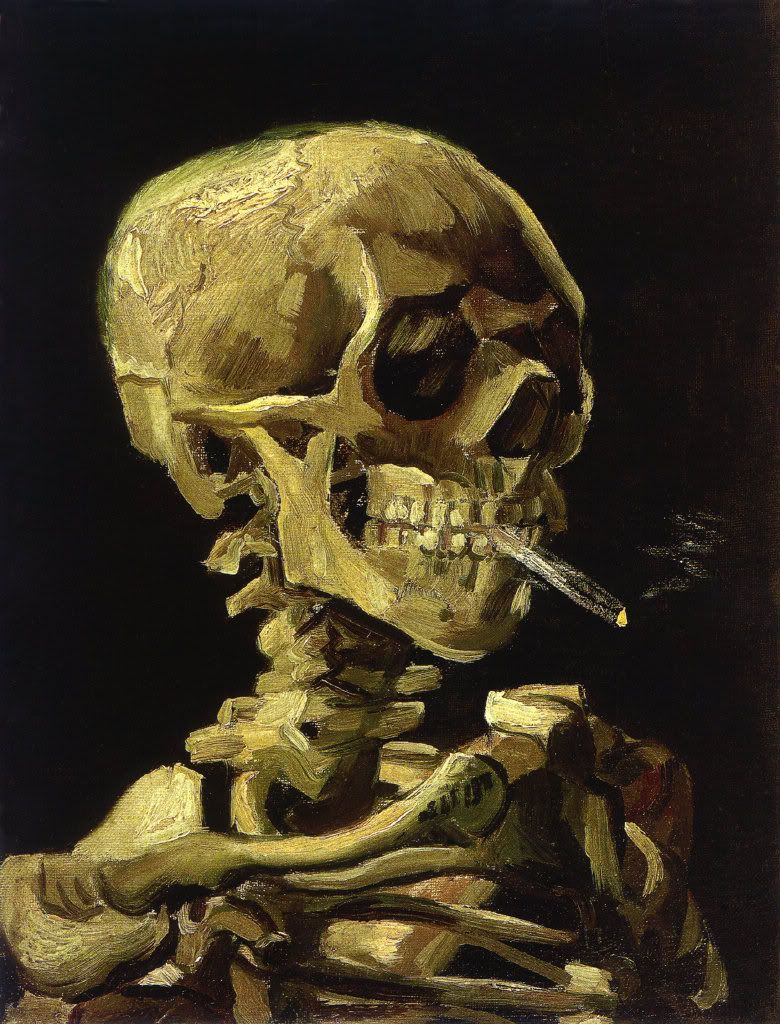
On her last day at the hospital, Dana got up and read a story inspired by a Van Gogh of a skeleton smoking a cigarette. She had to tell a story about the man and explain why he died, Dana turned it into about her father, herself, and even us that was so brutally honest I doubt many adults could manage it.

The man in this picture is what’s left of my father. Whether he died of a broken heart or of the lung cancer that the doctor diagnosed him of, I’m not sure. Maybe a combination of the two. But none the less, he’s gone and has been gone for over a year and a half. And I miss him. My father was my everything; my tear stopper, my secret keeper, my best friend. He lived forty-eight years, fourteen of them shared with me; but not near long enough. I think I’m losing it. It’s not the same anymore, and it never will be. Now I often hold things back, act like I’m okay. I’m not sure what emotions are right to fake anymore. Should I laugh or cry or maybe even smile.

My mother and I left one morning when my father wasn’t home; little did I know at the age of five that I wasn’t coming back. After many custody battles, I stayed with my mom during the week, and my father on the weekends. My dad smoked pretty much his whole life, and this is where the still lit cigarette comes into play. My father and I did everything together, but by the Christmas of my fourteenth year it all changed. I celebrated Christmas alone. He stopped doing things and slept most of the time. Little did I know that something far worse was going to happen.

By the next month, my dad was in the hospital and diagnosed with cancer. And within the next two months, my father died. He won’t see me graduate, and he won’t walk me down the aisle. His last words to me were that he loved me, and I know he did. But his love for me wasn’t enough for him to overcome his addiction. The cigarette is still lit, and my father isn’t coming back.

My doctor here in the hospital said I was superficial. I’m not trying to be superficial, but I just don’t understand how I am supposed to react to losing my father. I just feel numb.

Next time you think about lighting up, think about the people that love you: your family, your friends, your wife or husband, your boyfriend or girlfriend. Think of them all, and ask yourself if you are ready to take yourself from them. Or do you even care? For once, think about someone besides yourself and ask if they deserve what might be given to them. Do they deserve to lose you? Do you deserve to lose your life to something that could be prevented?

I myself at fourteen years of age was not anywhere close to being ready to lose my father, but maybe I’m being selfish. You can’t make decisions for other people, or my father would still be here. You can make decisions for yourself and your life and the people that you include in it. But when you make a choice, remember that it is not only you that is affected. That’s all I ask of you all, is just to think.


You have to understand that after a month of causing trouble, the staff really just did not like Dana. Everybody was more than ready to get her out of there. Despite that, after she finished reading and sat down, nobody clapped for several seconds, nobody spoke. She’s the only patient I’ve seen bring the audience to dead silence.

I don’t know where Dana or LaThomas or most of the kids go after they leave the hospital. I don’t really know where I’ll go once I leave. But I save each of the books they make every week. They crowd my shelf beside Huck Finn, Yossarian, and Randal Patrick McMurphy--all the voices shouting against madness and disappointment--because anybody going through the struggle of starting a new chapter deserves some small act of rememberance, a nod of respect.

X-posted on Kristopher's blog.

Best American Sports Writing

Bill Simmons, ESPN's Sports Guy, recently listed what he considers to be the greatest examples of sports writing ever. C. Max Magee of The Millions then traced all of the articles Simmons cited. A number of them are available online, and for those that aren't, Magee tells you where you can find them.

Also, if you're a fan of sports writing, don't forget about the Best American Sports Writing series. The 2008 edition was published earlier this month.

Tuesday, October 14, 2008

Paper Towns by John Green


Right now, you may be asking yourself a few questions. Like "hey, don't you usually talk about poetry? And isn't Paper Towns a novel? What gives?" Or maybe "What's with the two different covers? And who is the chick on the cover anyway?" You may be wondering what the title means, or even who John Green is. I hope to answer most of those questions in this post.

First off, I do usually talk about poetry. And today's selection is a novel, and one written in the usual way with full paragraphs and dialogue and stuff, and not one written in poems. Paper Towns tells the story of a high school senior named Quentin who has had a crush on Margo Spiegelman, the girl next door, since they were young kids who used to be just friends. And when I say "the girl next door", I'm not using a cliché; I mean it literally – he can see into her bedroom from his bedroom window, if she leaves the shade up. The chick on the cover is Margo. There are two covers because they are meant to represent the two sides of Margo: the cool, sly, popular girl on the yellow cover whom everyone admires, and the private, unhappy Margo that most folks know nothing about.

With weeks to go until graduation, Margo shows up at Quentin's window one night and convinces him to keep her company in a night of extreme pranksmanship. The next day, Margo is gone, leaving behind some "clues" for Quentin. Worried that Margo may have done something horrible and rash, Quentin sets out to find and follow the clues, which take him and his friends farther than they ever expected to go, and with rather surprising results.

Along the way, Quentin completes his senior year, including writing a final essay on Moby Dick in a way that I think might justify reading Paper Towns, if only to find new ways to think about and discuss Moby Dick if it's assigned reading. (Hint: if you pay attention in class, you can usually figure out what sort of thing your teacher is actually looking for, and with a bit of work, you can persuade your teacher to agree with him- or herself by serving up their own opinions couched in your words.)

What I'll tell you about the title: it means something specific, and it serves as a metaphor within the book as well. More than that I will not say. And as for John Green, the author of the book: he's won awards for his two previous novels, both of which I highly recommend: Looking for Alaska and An Abundance of Katherines. Last year, John and his brother, Hank, shot to internet stardom with their one-year vlogging project, Brotherhood 2.0, after Hank's musical offering, "Accio Deathly Hallows" went viral. It has resulted in an online community known as Nerdfighters, which includes social networking as well as social action components. John and Hank are getting ready to launch a national tour: tour dates can be found at the Nerdfighters website, accessible in the links to the left.

Paper Towns will be available for purchase beginning this Thursday, October 16th. And as for what this has to do with poetry . . .


And now, for the poetry portion of the post

The clues which Margo leaves for Quentin are tied up in the arts: a particular record album and highlighted passages from Walt Whitman's Leaves of Grass. Also in play within the book are the words of Sylvia Plath and Emily Dickinson. Whitman, Plath and Dickinson are quintessential American poets. Both Whitman and Dickinson forged new poetic styles, each of them working essentially on their own to create bodies of work that represent some of the finest poetry written in the 19th century. Plath, also an American poet, was known as a "confessional" poet, and a master of both free verse and complicated poetic forms such as the villanelle. She is also well-known for her confessional novel, The Bell Jar, in which she discusses her teenage depression and suicide attempt.

One of the poems specifically referenced in Paper Towns, which gives insight into Margo Roth Spiegelman and provides Quentin with plenty to think about, is "Song of Myself" by Walt Whitman, which comes from Leaves of Grass. "Song of Myself" is a long poem. Really long. And as the main character, Quentin, notes "the poem starts out really slowly – it's just sort of a long introduction, but around the ninetieth line, Whitman finally starts to tell a bit of a story." Not only does the book quote the poem, but it analyzes part of it as well. So if you're reading "Song of Myself" for English class, or for your own edification, you might want to read this book, too, just for the many times the poem is visited and, well, explained.

In "Song of Myself", Whitman presents a series of scenes that, taken together, tell not only a story of sorts, but explain some of his thoughts on poetry and his views on sexuality, among other things. The poem begins with these lines:

I celebrate myself;
And what I assume you shall assume;
For every atom belonging to me, as good belongs to you.


Scientific-minded readers will notice that Whitman's lines reflect the notion that everything is composed of atoms; spiritual-minded readers might notice that it includes as well the belief in a shared existence.

The lines from "Song of Myself" to which Quentin returns again and again are found in the sixth section of the poem, which is one of the most widely cited and most-discussed passages in the poem, and is the sixth section of the poem:

A child said, What is the grass? fetching it to me with full hands;
How could I answer the child? I do not know what it is, any more than he.

I guess it must be the flag of my disposition, out of hopeful green stuff woven.

Or I guess it is the handkerchief of the Lord,
A scented gift and remembrancer, designedly dropt,
Bearing the owner’s name someway in the corners, that we may see and remark, and say, Whose?

Or I guess the grass is itself a child, the produced babe of the vegetation.

Or I guess it is a uniform hieroglyphic;
And it means, Sprouting alike in broad zones and narrow zones,
Growing among black folks as among white;
Kanuck, Tuckahoe, Congressman, Cuff, I give them the same, I receive them the same.

And now it seems to me the beautiful uncut hair of graves.

Tenderly will I use you, curling grass;
It may be you transpire from the breasts of young men;
It may be if I had known them I would have loved them;
It may be you are from old people, and from women, and from offspring taken soon out of their mothers’ laps;
And here you are the mothers’ laps.

This grass is very dark to be from the white heads of old mothers;
Darker than the colorless beards of old men;
Dark to come from under the faint red roofs of mouths.

O I perceive after all so many uttering tongues!
And I perceive they do not come from the roofs of mouths for nothing.

I wish I could translate the hints about the dead young men and women,
And the hints about old men and mothers, and the offspring taken soon out of their laps.

What do you think has become of the young and old men?
And what do you think has become of the women and children?

They are alive and well somewhere;
The smallest sprout shows there is really no death;
And if ever there was, it led forward life, and does not wait at the end to arrest it,
And ceased the moment life appeared.

All goes onward and outward—nothing collapses;
And to die is different from what any one supposed, and luckier.


Whitman speaks to the interrelatedness of life, and the notion of (if you will) the Circle of Life.

Emily Dickinson, like Whitman and Plath, considered weighty issues like death, eternity and the search for meaning in life and death and, if you believe in it, the afterlife as well. Her poems were mostly untitled, and are usually referred to by first line if you go to look them up. Also? Almost all of her poems can be sung to your choice of the following songs: "Amazing Grace," "The Yellow Rose of Texas," or the theme from "Gilligan's Island." But I digress. Her poems also include a lot so f dashes. If you read her poems aloud, each dash indicates where a slight pause in recitation should occur. In the poem which follows, that means you'll be pausing at the end of every line except the penultimate (next to last) one, and some other places as well. The poem to which John Green (or, rather, his characters) make reference is Dickinson's "Forever is composed of Nows":

Forever — is composed of Nows —
'Tis not a different time —
Except for Infiniteness —
And Latitude of Home —

From this — experienced Here —
Remove the Dates — to These —
Let Months dissolve in further Months —
And Years — exhale in Years —

Without Debate — or Pause —
Or Celebrated Days —
No different Our Years would be
From Anno Domini's —


Returning to Whitman before the end of the post, here's the final section of "Song of Myself" (#52) and its oft-quoted lines. In them, Whitman talks of his legacy and bids his readers farewell:

The spotted hawk swoops by and accuses me—he complains of my gab and my loitering.

I too am not a bit tamed—I too am untranslatable;
I sound my barbaric yawp over the roofs of the world.

The last scud of day holds back for me;
It flings my likeness after the rest, and true as any, on the shadowed wilds;
It coaxes me to the vapor and the dusk.

I depart as air—I shake my white locks at the runaway sun;
I effuse my flesh in eddies, and drift it in lacy jags.

I bequeathe myself to the dirt, to grow from the grass I love;
If you want me again, look for me under your boot-soles.

You will hardly know who I am, or what I mean;
But I shall be good health to you nevertheless,
And filter and fibre your blood.

Failing to fetch me at first, keep encouraged;
Missing me one place, search another;
I stop somewhere, waiting for you.

Monday, October 13, 2008

He Said, She Said- Poison Ink by Christopher Golden


It's time for He Said, She Said, a newish feature for GuysLitWire in which Book Chic, a recent college graduate (male), and Little Willow, a bookseller (female), discuss books that will appeal to both genders.

In August, we talked about Play Me by Laura Ruby, a YA book written by a woman with a teenage boy as the protagonist.

This month, we're talking about Poison Ink by Christopher Golden, a terrific horror novel. Here we have a story written by a man with a teenage girl as the protagonist. Her four best friends, all female, round out the cast. Christopher Golden always does such a good job of getting into the mindset of a teen girl.

Do you prefer third person narration or first person narration in general? Does that preference depend on whether or not the gender of the narrator matches that of the author?

Book Chic: I generally prefer first person because it’s easier for me to get hooked into a story, though I have read and enjoyed third person narration before. But that could have been another reason why I wasn’t as into the book as I normally would be. When I read Lisa McMann’s “Wake” and E. Lockhart’s “The Disreputable History of Frankie Landau-Banks” (both AMAZING books), I was a bit jarred because of the third person and I had been reading lots of first person books before starting those. I don’t think it matters who’s writing it and whether they match, it’s more of a question of what kind I’ve been reading more of lately, and YA books do tend to lean more towards the first person than third.

Little Willow: I also loved Disreputable History. I like both first person and third person narratives, but I suppose I prefer first person. When I write stories with a female protagonist, I tend to use first person, but when I write with a male protagonist, I’m more likely to write in third person. In Poison Ink, Christopher Golden uses third person to relate Sammi’s story. He tends to use third person in his novels, no matter what the age or gender of the leading character. Whenever it calls for it, he always does a great job getting into the mindset of a teen girl. I don’t know exactly how he does it, but it’s really impressive. Have you read his mystery series called Body of Evidence? The main character there was also female – Jenna Blake, a college student, and one of my favorite characters created by Golden.

Who was your favorite character in the book?

BC: My favorite character would probably have to be Cute Adam, as I'm very much a sucker for male romantic leads, ha ha. I do hope that he and Sammi work things out eventually. I also really enjoyed Sammi since she was pretty much the main character of the novel. I really liked her for her perseverance, and for doing everything possible to help and save her friends.

LW: I liked Sammi as well. I feel as though I got to know her the best, since she was the main character, the filter through which readers saw the story unfold. However, since the narrative was in third-person, that allowed her some space as well.

Do you share personality traits with any of the five main characters?

BC: Like TQ, I'm quite shy, at least around new people, but once you get to know me, I am more outgoing. And while this isn't really a personality trait, I share the homosexuality aspect with Letty. I don't think I really shared any other traits with the five friends.

LW: The girls come together because they were floaters who didn't fit in any other groups at school. I really appreciated how different the girls were, and that they bonded despite those differences. When I was in high school, I knew people in various cliques and social circles. I didn't have a close-knit group of friends, though, like these girls do. As far as physical commonalities, let's see . . . Oh! I'm short, and so are Sammi and Caryn. Described as 5'3", they are three inches taller than I am.

Would you ever get a tattoo?

LW: No, never. I have no desire to ever get a tattoo. It's not about the pain or the health risks that may or may not be involved. Instead, it's that I value different forms of expression and art. I create things with my voice, my words, and my movement - speaking and singing, dancing and acting, writing and directing - rather than drawing anything on my skin. My ears are not pierced, and I never wear makeup unless I'm on stage or in front of a camera. I have never even dyed my hair, and don't plan on doing so unless a part calls for it; even then, if that ever happens, it will be temporary, and I will restore my hair to its natural color and state after completing the project. I understand that others have tattoos and piercings as expressions of art and of themselves, and that's fine— those methods simply aren't for me.


BC: I pretty much agree with you. I wouldn't get one for the reasons you described, but it is also about the pain for me. I'm very fragile, and do not like any sort of pain. I'm also worried about the long-term when it comes to tattoos and what happens when you get older. Not really a good thing. But I do quite enjoy looking at tattoos though; they are very beautiful, and usually there's a fascinating story behind it. Also, while it's not a requirement, it would be cool (and ok, kinda hot) if my future boyfriend had a tattoo on his arm or chest. But, for myself, tattoos are just not my thing.

Do you have any favorite scenes or quotes from the book?

BC: Other than the climax, not really, though I did also enjoy any scene between Sammi and Adam. Surprisingly, I don’t really pay much attention to specific lines or anything while reading, so I usually never think of favorite lines once I’m done.

LW: I LOVE the line, "Everything had been poisoned, and the poison was spreading." I used it at the book's website as well as my blog posts about the book because I thought it was such a great quote. It sums up the premise and it's just lovely. I picture the poison ink actually spreading, as if the jar had been tipped over.

Do you enjoy horror stories as a general rule?

BC: I’m not sure if I’ve read very many horror stories, or at least ones that were specifically horror. I do enjoy them, but I also tend to avoid them, as I am WAY easily scared and don’t need stories to help my imagination, lol.

LW: I like horror stories that are thought-provoking and plot-driven. When they are based on something psychological, they are even better. I love the original run of The Twilight Zone. It was smart and derived its horror from real things rather than relying on blood and guts. I don’t like a lot of modern horror films, especially not slasher flicks that are gory for gore’s sake, and I’m not a fan of cheesy special effects. Reading a book is different than watching a television show or film, because the reader has control over his or her mental theatre and imagination.

If this book were made into a movie, who would you cast in the main roles?

BC: Eep! I hate this question, as I’m sure authors probably do too. I’m never good at picking out people who look like the characters— that’s the casting person’s job and they’re good at it. I am not. For Sammi though, the person that I had in my head while reading the book was my friend Sammi since they had the same name, though I don’t think they look anything alike. Other than that, I can’t really remember if I pictured any of the characters as actual people. For Adam, maybe Michael Cera? I don’t know.

LW: If and when the book gets optioned for film, I’ll share my casting ideas with the powers-that-be. Until then, I’ll simply say that I’d hope the actors cast matched the character descriptions that Golden provided. I had a really clear picture of each character in my head.

Without giving too much away, what did you think of the villain, the climax, and the conclusion?

BC: I really liked the villain (well, how he was portrayed, not what he did). It was kind of a surprise how he turned, though you could see it even from the beginning. I enjoyed the twist in the book when Sammi went to see what was in his back room. As I said in my review, the climax was AMAZING. I loved it, and I seriously could not put the book down. The ending was really good too, though it wasn’t exactly what I expected. I won’t say more than that because I don’t want to ruin anything for the blog readers!

LW: You gave away the villain’s gender! *grin* I don’t want to spoil anything for potential readers either, so I’ll simply say that it was a killer ending.

This concludes Part 1 of our Christopher Golden He Said, She Said posts. Part 2 will be up hopefully later this month or in early November where we will discuss his October release with MTV Books, Soulless.

Five Quick Questions: Jeff Ackerman


Jeff is one of the most committed guys I know--committed to his family (he's a great dad to 2 college kids), to social change and justice, and to helping to educate others about our world. I've known Jeff for most of my 12 years in Denver, and New Year's Eve game night with him & his family is something I look forward to every year.

1. What do you do for a living and what do you like best about your job?

I am an advisor to the Colorado Public Utilities Commissioners. These are the people who regulate public utilities. I advise them on matters concerning how gas and electric utilities provide energy efficiency services to their customers (which is now required by law). What I like best about my job is that it blends together various activities/subjects that I enjoy: public policy; energy efficiency; economics; law; social justice.

2. Besides for simple information, why do you read?

I read as a form of recreation, in that a novel allows me to "travel" somewhere and experience something that I otherwise would not. I also enjoy seeing how others (authors) present topics of interest to me, in fictional form. For example, I have enjoyed various novels that present life in Korea, particularly around the time just after the Korean War, or during the Japanese occupation.

3. What did you read when you were a teen?

I did not read a lot of fiction when I was a teen, other than assigned reading. I recall "nerdy" reading -such as Alvin Toffler's Future Shock. I also read periodicals (U.S. News and World Report, The
Kiplinger Letter
) - Things my dad subscribed to. I also read various books on ecology/environmental science - such as Barry Commoner's The Closing Circle.

4. What book(s) do you wish you had read as a teen?

Classic literature - English and American classic authors. Dickens; Steinbeck; etc. Although difficult to read, I wish I had read some of Shakespeare's plays.

5. What are you working on now?

I am preparing to advise the three commissioners on a series of recommended decisions, in response to an application by Public Service Co. concerning how much energy efficiency they should pursue and how they should be compensated for their efforts.

Thanks for working towards energy efficiency and for answering our questions, Jeff!

Sunday, October 12, 2008

Favorite blogs


Special thanks to the folks at Charlesbridge who gave Guys Lit Wire an "I Heart Your Blog" mention with these fun words:

(Wait, what? Guys read? Well according to this blog they do, and they do it a lot)!

And also Michael at Crowe's Nest who did the same and wrote:

I really like Guys Lit Wire. They post new stuff all the time and do a really good job.

It's nice to be appreciated and since we are a such a big collaborative blog here, anyone who wants to chime in the comments with their favorite blog (or blogs) please do so!

Ink & Possession

Jack's always been the sidekick; the boring, steady, go-along guy, the perfect audience. Charlie's the fun one with the hip, dark looks, the right clothes and the cool attitude. However, when Charlie's Dad splits, even Charlie's cool is shaken. He's locked into a knot of pain and fury into which Jack is too timid to intrude, and when a stranger runs into him on a London street, Jack fears that Charlie's impulsiveness and rage is going to get the both of them neck deep in all kinds of unpleasantness.

As it turns out, Jack's right -- more right than he could possibly know. 'Cause what Charlie's gotten them into is a secret society -- that's supposed to guard the resting place of a demon whose only goal in his dark and twisted life is to awaken a dragon which will unravel the fabric of the universe.

Small detail: the demon's escaped, and the secret society members are dying, fast. They're in need of new members, and suddenly Charlie has all the right moves.


But ...where did he get them? And what gives with that cool black tat that's suddenly insinuated itself all over his back and down his arms?

But soon the bad outweighs the cool, and things get mucho, mucho weird. Charlie's not acting like himself. It may be it's not just his best friend in there anymore... from the black tattoo that flows over his body at times, Jack's figured it out: Charlie's possessed.

And it's up to boring, steady, go-along Jack

                      ...to go to hell and save the world.

This is... a trippy book, with some lighthearted moments that catch you by surprise and make it a little lighter. It may have as much in terms of deconstruction as you might want -- there are a few "whys" in the philosophical realm that get unanswered, but it's definitely fast-paced action and a sidekick character the reader actually cares about.

Buy this book from an independent bookstore near you!


X-posted at Readers' Rants.

Friday, October 10, 2008

The Breadth of Horror

Something I like a lot besides super-heroes is horror. Been reading a bunch of it lately and I'm discovering something interesting. Most of the horror you see in movie theaters has a certain sameness about it; mostly vengeful ghosts and axe-killers. Books and graphic novels expand and explore the genre and its possibilities with much greater breadth.
For example, maybe you've heard of Death Note (by Obah and Obata), the manga that's been adapted into just about every other medium possible. Have you seen the movie version? The anime version? Read the novel? Well, let me tell you, I can't imagine any of them beating the original manga for a sense of originality and suspense.

In Volume One, we're introduced to gifted student Light (the English translations often give the characters some bizarre names) who stumbles upon the Death Note, which was dropped mistakenly (?) by a Shigumi Death God. All you need to do with the book is write down in it the name of a person whose face you can picture and that person drops dead of a heart attack. Now Light is not you average sort and he decides he's going to create a new world using the power of the book. So, when criminals throughout the world start inexplicably dropping dead of heart attacks, an international police force calls upon legendary detective L to solve the case. Thus begins a 13 volume opus that tracks the cat and mouse game between the two brilliant players with the power of life and death hanging in the balance.

On top of floating death gods and the fascinatingly unbalanced character of Light himself, top it off with the cleverly Sherlock Holmesian-deductions of brilliant detective L (he determines that the untraceable killer is a Japanese high school student within a day of coming on the case) and you've got much more than your standard scare-fare here. Part of the real joy is watching the battle of wits between the two and the truly unexpected twists and turns. Since the whole tale runs 13 volumes, there is no shortages of surprises, and I personally guarantee that the story will keep you unsure of what's coming next up to the very end.

Now, if you're looking for something truly bizarre in your horror, you will find nothing better then The Nightmare Factory (by Moore and Harris, but based on the short stories of Thomas Ligotti). There are four stories here, all by different teams contributing artwork that is fittingly strange. These are stories filled with sinister winter festivals, disappearing theaters, rotting insane asylums and a girlfriend who can unravel reality. You simply cannot get further from the sameness of recent horror movies than this thing (along with the prose stories they're based on), which are about as non-standard and non-conformist in their ideas as I've ever seen.

Honestly, these stories touch horror at its eeriest and most disturbing, filled with unexplainable, inevitable and encroaching dread from beginning to end. A second volume just came out recently, titled The Nightmare Factory Volume 2 (also by Moore and Harris based on Ligotti). I haven't read it yet, but if you do, let me know what you think.