Wednesday, February 27, 2013

The Treasure of Alpheus Winterborn

The Treasure of Alpheus WinterbornThe Treasure of Alpheus Winterborn by John Bellairs

Eccentric millionaire (is there any better kind?) Alpheus T. Winterborn built a castle-like building which houses the Hoosac Public Library. It also houses a great treasure, or so the stories go. One day, young page Anthony Monday finds a gold coin hidden in the molding and begins to think there's truth to this crazy story. Unfortunately, so does Hugo Philpotts, Winterborn's greedy nephew. With the help of Miss Eells, the town librarian, Anthony races to find the treasure and save his family from financial ruin before Mr. Philpotts can get his sinister claws into the treasure.

I was inspired to pick up this book in part because I have a gaping hole in my knowledge of juvenile and middle grade
 fiction, a hole that's only gotten deeper since I moved up into the adult services division at work. I was also in the mood for a good solid mystery, and who can resist a mystery in which a plucky youngster and a librarian team up? And I think I was also inspired by previous posts here in Guys Lit Wire on the Pursuit of Lost Books.

Monday, February 25, 2013

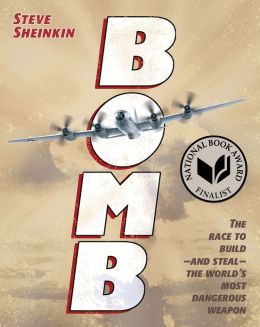
Bomb: The Race to Build–and Steal–the World's Most Dangerous Weapon by Steve Sheinkin

cover of Bomb by Steve Sheinkin
In December 1938, a German scientist named Otto Hahn made a discovery that would change the world. Given what scientists knew at the time, the results of Hahn's experiment at first seemed wrong. Impossible. Unbelievable.

Writing to Lise Meitner, his former collaborator, Hahn explained what he'd found. Meitner and her nephew, Otto Frisch, were physicists, and though  both were amazed by Hahn's news, Meitner was also aware that "We have experienced so many surprises in nuclear physics that one cannot say without hesitation about anything: 'It's impossible.'" (p. 14) Sketching a diagram and doing some math, Meitner and Frisch realized it was, in fact, possible to split an atom. Not only that, but the energy released by splitting an atom is immense. And if you had enough uranium and figured out how to split all those uranium atoms at the same time, you would have the most powerful bomb ever.

The only question was, who would get the bomb first?

Remember, this happened in late 1938. Germany, with its long tradition of scientific achievement—particularly in physics—was led by Adolf Hitler and had already occupied and annexed Austria. Czechoslovakia is in its sights, and World War II will begin not much later, in 1939.

Wednesday, February 20, 2013

Slam! by Walter Dean Myers

I was supposed to post this last week, but was distracted and forgot. Slam! is a good basketball story. Very good, in fact. So here's an excerpt:

Coach went around... telling everybody not to feel bad. He was feeling bad, though, and you could see that all over his face...

Me and Ducky started to the bus stop and a car pulled up. It was Ducky's mom.
"Can we drop you someplace?" she asked.
"Bet."
Yo, Ducky's mom was fine. If she wasn't white and about thirty-something I might have given her a play. She got the hint real quick that we had blown the game and went on about how crowded it was downtown. Ducky didn't want to hear that mess and neither did I so she shut up.
"I'll come to the next game if I can," she said when she left me off on 145th.
"You lucky?" I asked.
"I think so," she said, and flashed me a pretty smile.
I got upstairs and a little big-eyed boy named Donnie was standing on the landing.
"Your father got shot," he said.
I busted down the hall and saw the door was unlocked. My heart was jumping when I ran in. Moms was making coffee at the stove and Derek was reading a comic.
"Where's Pops?" I asked.
"He's in the living room watching television," Moms said. "You hear he broke his arm?"
"Broke his arm?" I looked down the hallway toward the living room but I couldn't see nothing. "Donnie said he got shot."
"He's only four," Moms said. "Anytime somebody gets hurt around here the little kids think they got shot. No, he just broke his arm."

Tuesday, February 19, 2013

So Depressing it Could be a Post-Apocalyptic Nightmare but it Isn't

I'm working on a new genre category in which to place Andrew Smith's In the Path of Falling Objects. Apocalyptorical Fiction? Dystopical Fiction?

This novel, an earlier offering by the author of The Marbury Lens, features a bleak, empty landscape populated with the desperate and violent fringes of humanity. It has a lot in common with post-apocalyptic fables like Cormac McCarthy's The Road. But this novel is not set in some near future that has suffered an environmental or nuclear holocaust, showing us a world devastated by human stupidity. Instead it is set in the very familiar American Southwest and not in the future at all, but in the recent past, in the 1960s.

Monday, February 18, 2013

Not Always Better Down Where It's Wetter: The Vicious Deep, by Zoraida Córdova

One thing you have to say for mermaids - they've had a lot of press. If I simply say the phrase, "Under the Sea," even if you never suffered through primary-colored Disney fare, you still have a horrible little calypso earworm going on in your head, right? (Yeah, sorry about that.)Zoraida Córdova - pronounced zor-EYE-duh - is an Ecuadorian author who came to the English language by way of watching The Little Mermaid and Michael Jackson's Moonwalker over and over. She grew up in Jamaica/Hollis, Queens, and she is doing for merfolk what Holly Black did for fairies back in the day. Forget Ariel and that crab Sebastian. There's a lot of vicious out there, rolling in the deep...

(Yeah, now you've got TWO songs in your head. I did that for YOU.)

Sunday, February 17, 2013

What Went Wrong


In the world of television news the phrase "if it bleeds, it leads" determines which of the days news items are most important. Loss of life and natural calamity are deemed more newsworthy because the human element within the story – these things could have happened to us – draw us into their seductive thrall. Even popular entertainment feeds our attraction to peril with fictitious disasters that echo those we have encountered before.

In the early days of these disaster the question on everyone's mind, right after "What just happened?" is "What went wrong?" These questions are as much about our natural curiosities as they are about learning what we can and perhaps avoiding them in the future. Popular Mechanics' What Went Wrong turns the questions into a collection of explanations for some of the worst man-made and natural disasters of the last 100 years.

Books like this have existed for decades – I read a similar book put out by Reader's Digest back in the day – but what I like about this one is its approach to what it calls "disaster forensics," bringing scientific explanations to everything from classic disasters like the 1901 San Francisco earthquake and the 1956 sinking of the Andrea Doria to more modern events like Hurricane Katrina and the Deepwater Horizon oil spill.

Friday, February 15, 2013

Polydactylism and Prison Breaks: The Twelve-Fingered Boy, by John Hornor Jacobs

FIRST, you should read John Scalzi's hilarious chat with the author of this book, John Hornor Jacobs, and find out a little more about it. There's his crusty old man, Grumps, there's talk of Southern Gothic, there's poetry, and a whole lot more.

No, go on. Read it. I'll wait.

...

Back now? Great.

Taking a look at this book from the outside in, I can't say that I love the cover - it's striking, but there's a certain horror movie aspect to the Great Massive Hands Of Doom erupting from the dark woods and hovering above the skyline... that never happened. On the other hand, red, black, and gray work well, and at least there's no pink.

As for the book itself, to be honest, it's kind of a hard book to review. Not because of the plot - the story's rock solid - but because it's hard to convey whose side we should be on. Do the bad guys really mean harm? Is the narrator - in juvie - at all trustworthy? Can you be sure of what you see? This is the first salvo in the INCARCERADO trilogy and is fast-paced, intense, and gritty. Without the lift the humor provides, this book could be seriously depression - because it's a lot about reality. To add a little balance to my gushing about this novel, I'll say that some scenes near the middle could have been shortened - but there's also this ambiguity for the reader about Shreve's behavior near the around then, too. Who knows, maybe it's perfect as it is! I can see this novel being well received by those not interested in the usual YA speculative fiction fare. It's got a "buddy movie" blend of stupid behavior, bad language, and depressing realities - with a surprising bit of heart.


Tuesday, February 12, 2013

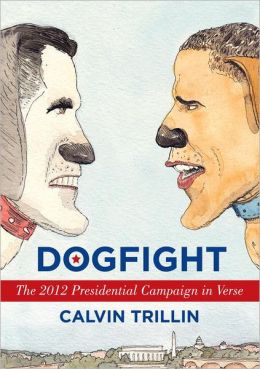
DOGFIGHT by Calvin Trillin

Calvin Trillin, the man who brought us Deciding the Next Decider, is back with DOGFIGHT: The 2012 Presidential Campaign in Verse. Fans of politics and/or poetry will like this, as will folks who like stuff that is funny.

The book opens with this poem as a prelude:

Let the Barking and Biting Begin
by Calvin Trillin

Mitt Romney put Seamus on top of the car.
("He liked it up there, and we weren't going far.")
Obama, in boyhood, while in Indonesia,
Once swallowed some dog meat without anesthesia.
Though dog lovers wouldn't be either man's base,
A dogfight seemed what was in store for their race.
And people were saying, "We wonder which dude'll
Emerge as the pit bull, and which as the poodle."
The next two chapters of the book cover the start of Obama's first administration in 2008 and the mid-term elections in 2010, followed by a number of chapters about the Republican primaries, including poems savaging many of the contenders (much as those contenders savaged one another). By page 83, though, it's pretty clear that Mitt Romney is going to be the GOP candidate, and Trillin gives us this gem:

The Republican National Committee Selects a Campaign Slogan
by Calvin Trillin

Our slogan's been chosen.
We think it's a hit.
We'll shout from the rafters,
"We've settled for Mitt!"

Monday, February 11, 2013

The Last Policeman by Ben Winters


I like my eggs runny and my detectives hardboiled. My women mysterious. And my disaster scenarios pre-apocalyptic. So when this oddball noir The Last Policeman walked its way into my hands, I forgot about the past and thought again about the future. Our future. The one that doesn’t exist.