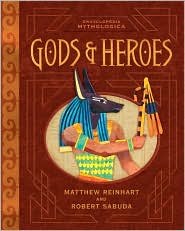
 Today, I'm recommending Encyclopedia Mythologica: Gods & Heroes by Robert Sabuda and Matthew Reinhart, the talented creators of beloved pop-up books including versions of The Wonderful Wizard of Oz and Star Wars: A Pop-Up Guide to the Galaxy.
Saturday, February 27, 2010
Because you're never too old for a pop-up book . . .
Today, I'm recommending Encyclopedia Mythologica: Gods & Heroes by Robert Sabuda and Matthew Reinhart, the talented creators of beloved pop-up books including versions of The Wonderful Wizard of Oz and Star Wars: A Pop-Up Guide to the Galaxy. 
Friday, February 26, 2010
Sometimes Even Sherlock Holmes Has to Look Something Up
Let's talk handbooks.
I loved them as a boy, handbooks of all kinds covering everything from model railroading to rocketry; they were books that you could make happen in the real world. It was only later that I realized that almost any book can be a handbook. What's The Great Gatsby, after all, but a handbook on how to woo a woman by being a cool and mysterious millionaire?
The one I carried most was the Boy Scout Handbook. Need to hitch up a horse or a boat? It has you covered. Want to bake a potato in aluminum foil beneath a bed of coals? It'll tell you how. Trying to follow a deer? Bingo, it's here. Hiking, camping, lifesaving, even the rudiments of morality: this book has plenty to offer the enterprising and adventuresome lad.
But can it tell you how to make a dramatic entrance? How to analyze footprints, fingerprints, typography, or bullets? What if you need to fake your own death by surviving a plunge into a waterfall? I don't remember that from my Scout handbook, and I could have used it more than once, let me tell you.
These are all necessary skills for the really enterprising and adventuresome lad. Even cavemen knew how to hike and camp, but only The Sherlock Holmes Handbook by Ransom Riggs can teach you to find a secret chamber or examine a crime scene with flair and panache.
I loved them as a boy, handbooks of all kinds covering everything from model railroading to rocketry; they were books that you could make happen in the real world. It was only later that I realized that almost any book can be a handbook. What's The Great Gatsby, after all, but a handbook on how to woo a woman by being a cool and mysterious millionaire?
The one I carried most was the Boy Scout Handbook. Need to hitch up a horse or a boat? It has you covered. Want to bake a potato in aluminum foil beneath a bed of coals? It'll tell you how. Trying to follow a deer? Bingo, it's here. Hiking, camping, lifesaving, even the rudiments of morality: this book has plenty to offer the enterprising and adventuresome lad.
But can it tell you how to make a dramatic entrance? How to analyze footprints, fingerprints, typography, or bullets? What if you need to fake your own death by surviving a plunge into a waterfall? I don't remember that from my Scout handbook, and I could have used it more than once, let me tell you.
These are all necessary skills for the really enterprising and adventuresome lad. Even cavemen knew how to hike and camp, but only The Sherlock Holmes Handbook by Ransom Riggs can teach you to find a secret chamber or examine a crime scene with flair and panache.
Thursday, February 25, 2010
The Good Soldiers by David Finkel

Readers like to put books into mental categories. The best books for this and the best books for that. While these sets of books are often in flux, some stay with us forever. There are books that will always be in one category or another. They made us howl with laughter, they kept us up into the wee hours of the morning with fear and anticipation, they ripped out a piece from our heart, or took us to an exceptional place in our own lives. There is also that special category; a handful of books that we know as we turn page-after-page, will be among the best we have ever read. But more than being the best, we know they are important. We know they will change us. It does not happen too often, but there are times when I’m reading a book and my brain tells me that I will be a better person having read these pages. That’s how I feel about David Finkel’s The Good Soldiers.
This book is not for the faint at heart. It is violent. There were times when I was reading it that I set the book down to take a breath.
The writing is gorgeous. As I look back now, in some ways the book reminds me of Cormac McCarthy’s dystopian novel, The Road. They are both bleak and brutal with stunning prose that leaps off the page. The difference, of course, is that McCarthy’s book is fiction. But they are both about dystopian madness. One just happens to be taking place today.
Wednesday, February 24, 2010
Inventory

Inventory is a book of "obsessively specific" lists collected from the The Onion's A.V. Club Website.
The idea is sublime, the execution is excellent and the lists are sometimes great, sometimes good and sometimes skippable.
But that's the nature of a book with lists such as:
"18 Songs about Specific Films"
"16 Film and TV Characters Who Knew Exactly What They'd Like to Eat"
"5 Crazy-Ass Members of the Legion of Superheroes"
"10 Hilarious On-screen Drug Freakouts"
"10 Great Songs Nearly Ruined by Saxophone"
Tuesday, February 23, 2010
The Poison Eaters & Other Stories
So unless you've been living under a rock, or perhaps a bridge, you should have heard of Holly Black. She did this Spiderwick series... which became a movie after selling more copies than there are specks of glitter in Stephanie Meyer's work. And before that she wrote Tithe, an amazing surburban dark fantasy. So what the hell is she doing writing short stories? The answer is simple: she's kicking ass!
Monday, February 22, 2010
The Breach by Patrick Lee
 First, a word of warning about Patrick Lee's The Breach: there are some disgustingly gruesome scenes in here, including one that is almost Gretchen Lowell-worthy.
Anyway, I went into this novel expecting fast-paced, adrenaline-filled entertainment, and this is exactly what I got.
After spending more than a decade in jail, Travis Chase left Minnesota for Alaska. On the first anniversary of his release, Travis sets off on a solo hike, avoiding as many people as possible. A few days into the hike, he spots the wreckage of a plane. The crash is recent, but strangely, there is no sign of helicopters or search-and-rescue teams in the area. Even more disturbing, everyone on the plane is dead, and not because of the crash itself. They'd all been shot.
Friday, February 19, 2010
Have Clues, Will Travel: Luke Harding, F.I.
 How would you like your mystery served with a side of science fiction? I found I liked it just fine.
In Futuristic England, where the North is posh, and the South -- including London and Cambridge -- is a lawless, slum-infested disaster, the Authorities have taken over.
The Authorities are everything -- your parents, your teachers, and Big Brother, all rolled into one. They've instituted a few programs, to insure maximum productivity, prosperity and satisfaction for those who participate. The Authorities are in charge of childcare centers, educational facilities and job placement. When you come of age, The Authorities will also arrange a Pairing for you, because they know you best, and can do better at hooking you up with your future mate than you could ever do yourself.
 There are few surprises in this new world, because The Authorities strive to take the surprises out of life. There are no more extremes -- most people are a homogeneous light brown -- a perfect multicultural mix. Most people do what they're told, take the jobs they're suited for, and the Pairings they're given. The Authorities don't seem that bad...to most people...mostly...
Thursday, February 18, 2010
Short Story Remix 2: Discovering some classics
About a year and a half ago, I mused on the possibilities of creating your own short story collection. How, in this day and age of music shuffles and home-grown compilations, that it would be cool to put together a list of short stories that you would put into your own anthology. It’s about time to do that again, I think. Only, this time, I want to make a collection composed of nothing but freebies, works in the public domain. And to do so, we’re going to reach way, way back, to old stuff, and see if, in putting them together in a new context, we can see them not in a moldy-oldy kind of way, but see them fresh, see them as something new…
When being a teen is really all about survival
Tales of the Madman Underground by John Barnes just might be one of my favorite reads of all time. Set during one week in 1973, it's the story of high school senior Karl Shoemaker’s last-ditch attempt to be normal. Achieving that goal is no easy feat, however, for Karl is a long time member of the “Madman Underground," a group of teens with a variety of troubling family issues that has marooned them in mandatory group therapy sessions. Karl’s father, the town’s former mayor, is dead from cancer, and his hippie mother is a binge partier who has filled their house with cats. The other kids in the group are struggling with incest, alcoholism, physical abuse, emotional abuse, neglect, and just flat out family weirdness. What they have in common is being branded by teachers as screw-ups, then doomed to an endless array of therapists who don’t know what they're doing. The Madmen struggle along through chaos at home, varying degrees of teasing at school, and some true terror in their own minds. The week of normal that Karl embarks on ends up being a hugely significant period in all of their lives, culminating in the moment they embrace a communal friendship long denied, but stronger than any of them had anticipated. It’s also about a hell of a lot more than that and has some killer writing that should not be missed.
Barnes covers dozens of high school tropes, but turns them on their heads with ease. From the coach/lit teacher who insists that Huck Finn is not “a story about a couple of queers on a raft,” to the idiotic bullies, jocks, socials, farm boys, band geeks, drama queens, hoods, and on and on. Everyone you expect is here, but by definition the Madmen belong to themselves more than any clique, even though several walk a border between popular and weird. They can never separate themselves from the fact that once a week they are all together because something is wrong with them, and it can’t be fixed. Operation Be Fucking Normal is all Karl can think about, but high school is a narrative all its own, that can't be stopped no matter how hard you try. Karl juggles four jobs, keeps the house clean, buries the cats when the raccoons get them, attends AA meetings faithfully, and dreams of normalcy, but there is still the fact that the people he cares about most in the world -- and the ones who understand him better than anyone -- are all different kinds of not normal. Fortunately, Karl figures that out early on, and the story becomes more about survival and the benefits of being true to who you are, and who you want to be.
This is not a sweet or simple story, and at moments, the reality of what the Madmen suffer through can be quite daunting. But that is the point, as Barnes illustrates so perfectly in one passage: "While Huck had these problems, Tom Sawyer just wanted to play stupid games about being robbers and things -- that was something us Madmen talked about all the time, the way kids getting raped or beaten were sitting in class next to kids whose biggest concern was what to wear for homecoming.” Karl has problems, and so do his friends. Separately they're adrift, but together, even in the unlikeliest of circumstances, they save one another. In the end, there are a few adults as well who chip in when Karl needs them, and while no one in this story is perfect, a lot of them are decent and kind and good. And the Madmen prevail against mean classmates and foolish parents and really crappy circumstances. If that doesn’t make for a truly epic coming-of-age tale, I don’t know what does. Tales of the Madman Underground is one for the ages, pure and simple. A must read.
Cross posted from my Bookslut column - Tales was named a Printz Honor title for 2009.
Barnes covers dozens of high school tropes, but turns them on their heads with ease. From the coach/lit teacher who insists that Huck Finn is not “a story about a couple of queers on a raft,” to the idiotic bullies, jocks, socials, farm boys, band geeks, drama queens, hoods, and on and on. Everyone you expect is here, but by definition the Madmen belong to themselves more than any clique, even though several walk a border between popular and weird. They can never separate themselves from the fact that once a week they are all together because something is wrong with them, and it can’t be fixed. Operation Be Fucking Normal is all Karl can think about, but high school is a narrative all its own, that can't be stopped no matter how hard you try. Karl juggles four jobs, keeps the house clean, buries the cats when the raccoons get them, attends AA meetings faithfully, and dreams of normalcy, but there is still the fact that the people he cares about most in the world -- and the ones who understand him better than anyone -- are all different kinds of not normal. Fortunately, Karl figures that out early on, and the story becomes more about survival and the benefits of being true to who you are, and who you want to be.
This is not a sweet or simple story, and at moments, the reality of what the Madmen suffer through can be quite daunting. But that is the point, as Barnes illustrates so perfectly in one passage: "While Huck had these problems, Tom Sawyer just wanted to play stupid games about being robbers and things -- that was something us Madmen talked about all the time, the way kids getting raped or beaten were sitting in class next to kids whose biggest concern was what to wear for homecoming.” Karl has problems, and so do his friends. Separately they're adrift, but together, even in the unlikeliest of circumstances, they save one another. In the end, there are a few adults as well who chip in when Karl needs them, and while no one in this story is perfect, a lot of them are decent and kind and good. And the Madmen prevail against mean classmates and foolish parents and really crappy circumstances. If that doesn’t make for a truly epic coming-of-age tale, I don’t know what does. Tales of the Madman Underground is one for the ages, pure and simple. A must read.
Cross posted from my Bookslut column - Tales was named a Printz Honor title for 2009.
Tuesday, February 16, 2010
Ronald Kidd's The Year of the Bomb
 Ronald Kidd's The Year of the Bomb is a book I wish I'd thought of. I don't say that about many books. I don't particularly wish I'd thought of Harry Potter, for example (though it could be fun living in a Scottish castle, if you could keep the thing reasonably temperate), since it's different than what I write. But Kidd's "Bomb" is a very unusual stew of politics, film iconography, history and California specificity -- all in a terrific cautionary tale about what happens when we let fear dictate laws and policy.
It's the kind of blend I've attempted to go after in my own writing, but was here duly impressed with the easygoing way Kidd mixes his elements: In the mid-50's. a group of 12(ish) year olds are watching a film being shot in their home town of Sierra Madre, California: The original Invasion of the Body Snatchers, directed by Don Siegel, and staring Kevin McCarthy. Based on Jack Finney's cautionary tale about pod people taking over "real" personalities, it's been remade several times, though the original served as a kind of postwar Rorschach test: Was it about the perceived threat of "Communist" conformity we were allegedly fending off from the East? (Before all our factories were located there) Or was the story about Americans giving up their own "free will" in the face of Senator Joe McCarthy's paranoid investigations of "domestic enemies?"
Or both?
 Here, Kidd pretty firmly comes down on the latter interpretation, while following the adventures of a certain Paul, and his pals Crank, Oz, and Arnie. They're already movie buffs, having ventured into L.A. to catch matinees, and when Body Snatchers comes to their own town, they're smitten with the Klieg lights of Hollywood. They're also smitten with a young actress named Laura, after whom they lust and love. Which means -- speaking as a former 12 year old boy -- they're constantly awkward and tongue-tied in her presence.
Kidd also brings legendary physicist Richard Feynman into the plot. Feynman lived nearby, and taught at Caltech in Pasadena. In his pre-Nobel Prize days, he was also briefly suspected of potentially being a spy, primarily because he expressed well-founded regrets on having helped develop the atomic bomb.
And of course, as Kidd's story ably tells us, once a state confuses healthy dissent with treason, we're all on the way to becoming Pod People, ourselves.
This is just one of the realizations Paul has in this coming of age -- hitting that age while simultaneously wishing he could be a grown up (in his pursuit of Laura), while also realizing grown-ups are much less sure of themselves, or life's "answers," than they let on.
But aside from its necessary and timely themes, the book's pleasures also rest in the deft blend of real characters with fictional ones, and its assured sense of place (SoCal of the era is vividly recreated), along with its knowledgeable grounding of movie making, and what sets and sound stages are like.
As the publishing biz itself becomes more and more like Hollywood filmmaking, it's somewhat surprising "a book like this got made" -- as we say about studio films that still manage to, well, surprise us.
I am, however, very glad it did.
Subscribe to:
Posts
(
Atom
)